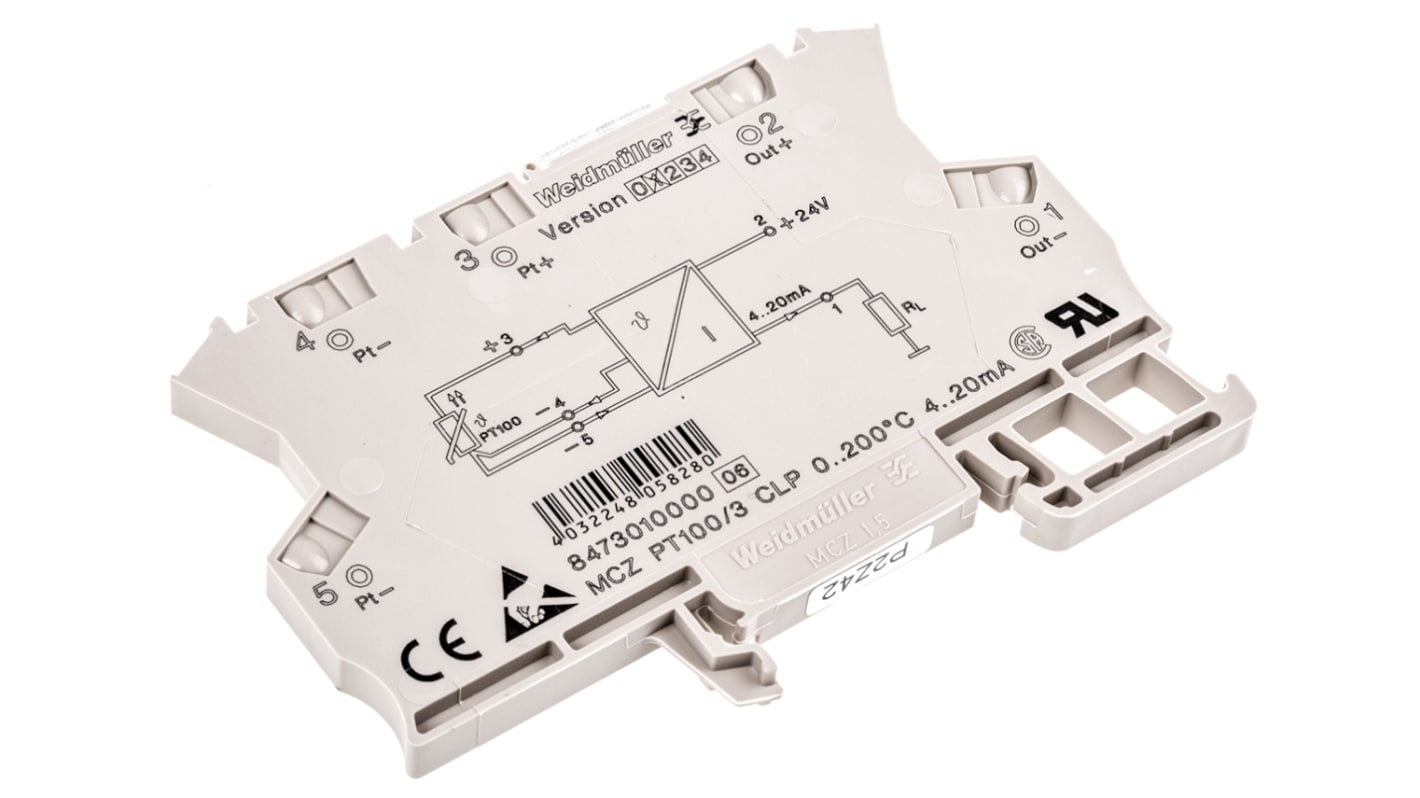
Weidmüller ACT20X Series Signal Conditioner, RTD Input, Current Output, 30V dc, 9 V dc Supply
- RS Stock No.:
- 393-0184
- Distrelec Article No.:
- 303-74-064
- Mfr. Part No.:
- 8473010000
- Brand:
- Weidmüller

Subtotal (1 unit)*
£72.62
(exc. VAT)
£87.14
(inc. VAT)
FREE delivery for orders over £60.00
In Stock
- 71 unit(s) ready to ship
- Plus 28 unit(s) ready to ship from another location
- Plus 97 unit(s) shipping from 18 May 2026
Need more? Click ‘Check delivery dates’ to find extra stock and lead times.
Units | Per unit |
|---|---|
| 1 + | £72.62 |
*price indicative
- RS Stock No.:
- 393-0184
- Distrelec Article No.:
- 303-74-064
- Mfr. Part No.:
- 8473010000
- Brand:
- Weidmüller
Specifications
Technical Reference
Legislation and Compliance
Product Details
Find similar products by selecting one or more attributes.
Select all | Attribute | Value |
|---|---|---|
| Brand | Weidmüller | |
| Product Type | Signal Conditioner | |
| Input Signal Type | RTD | |
| Output Signal Type | Current | |
| Input Range | 0 → 200 °C | |
| Output Range | 4 → 20 mA | |
| Supply Voltage | 30, 9V dc | |
| Hazardous Area Certification | NO | |
| Mount Type | DIN Rail | |
| Terminal Type | Plug-In | |
| Minimum Operating Temperature | -25°C | |
| Maximum Operating Temperature | 50°C | |
| Signal Conditioner Type | Analogue Signal Processing | |
| Standards/Approvals | UL, CSA, EN 50081-1, EN 50082-2, CE | |
| Series | ACT20X | |
| Number of Channels | 1 | |
| Select all | ||
|---|---|---|
Brand Weidmüller | ||
Product Type Signal Conditioner | ||
Input Signal Type RTD | ||
Output Signal Type Current | ||
Input Range 0 → 200 °C | ||
Output Range 4 → 20 mA | ||
Supply Voltage 30, 9V dc | ||
Hazardous Area Certification NO | ||
Mount Type DIN Rail | ||
Terminal Type Plug-In | ||
Minimum Operating Temperature -25°C | ||
Maximum Operating Temperature 50°C | ||
Signal Conditioner Type Analogue Signal Processing | ||
Standards/Approvals UL, CSA, EN 50081-1, EN 50082-2, CE | ||
Series ACT20X | ||
Number of Channels 1 | ||
- COO (Country of Origin):
- RO
Weidmuller Signal Conditioner, Temperature Converter, 0°C to +200°C Input Temperature Range - ACT20X Series - 8473010000
Keep your signals in top form with this signal conditioner from Weidmuller. It allows you to convert a temperature reading from a PT100-type RTD sensor into a current output signal that your equipment can use. The module is easy to install, as it uses a simple tension clamp connection and clips onto a DIN rail. Thanks to a wide temperature input range between 0°C and +200°C, you can use this module in demanding applications.
Features & Benefits
• Compatible with two and three-wire PT100 sensors for versatility
• Accepts wire sizes between 22 and 12AWG for broad compatibility
• Supply voltage range between 9 and 30V DC for use in low-power systems
Applications
• Factory automation
• Energy production
• Transportation sector
How does an RTD temperature sensor work?
RTD sensors contain a strip of metal. The metal's resistance increases as its temperature increases. When electricity passes through the sensor, it measures the level of resistance to the current, converting it to a temperature reading based on the properties of the element used.
Related links
- Weidmüller ACT20X Series Signal Conditioner Current Output, 9/30 V dc Supply
- Phoenix Contact MINI MCR Series Signal Conditioner Current Output ATEX
- Phoenix Contact MINI MCR Series Signal Conditioner Current/Voltage Output ATEX, IECEx
- Weidmüller ACT20X Series Signal Conditioner Current Output, 30 V Supply
- WAGO Jumpflex Series Signal Conditioner Current Output, 30 V Supply
- Phoenix Contact 3RS7025 Series Signal Conditioner Current/Voltage Output ATEX
- Seneca K109 Series Signal Conditioner Current/Voltage Output, 30 V Supply
- Phoenix Contact MINI MCR Series Signal Conditioner Current/Voltage Output ATEX