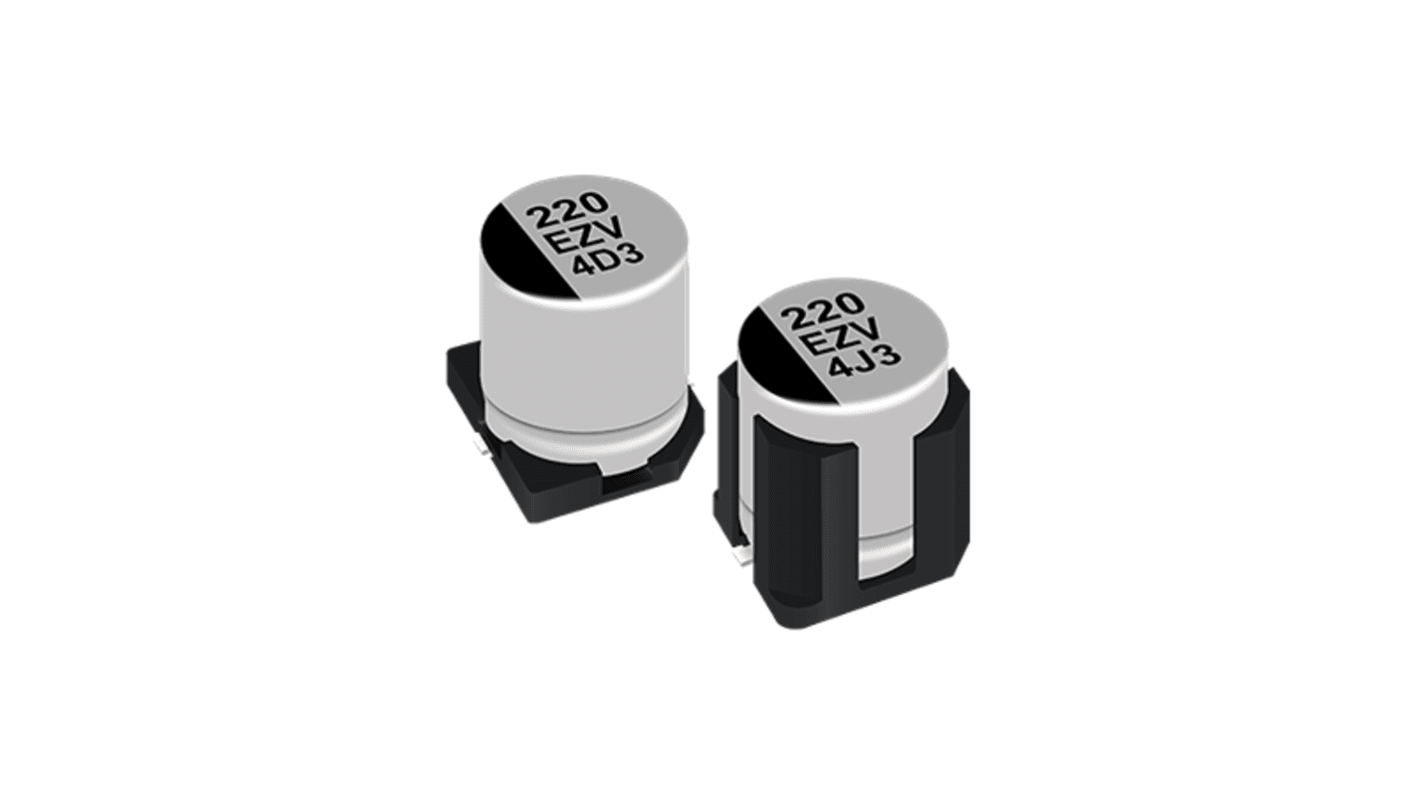
Panasonic 270 μF Polymer Capacitor 35V, Surface - EEHZV1V271P
- RS Stock No.:
- 434-041
- Mfr. Part No.:
- EEHZV1V271P
- Brand:
- Panasonic

Bulk discount available
View bulk pricing optionsSubtotal (1 pack of 5 units)*
£12.09
(exc. VAT)
£14.51
(inc. VAT)
FREE delivery for orders over £60.00
In Stock
- 275 unit(s) ready to ship
- Plus 1,000 unit(s) shipping from 18 September 2026
Need more? Click ‘Check delivery dates’ to find extra stock and lead times.
Units | Per unit | Per Pack* |
|---|---|---|
| 5 - 45 | £2.418 | £12.09 |
| 50 - 245 | £1.958 | £9.79 |
| 250 - 495 | £1.498 | £7.49 |
| 500 + | £1.332 | £6.66 |
*price indicative
- RS Stock No.:
- 434-041
- Mfr. Part No.:
- EEHZV1V271P
- Brand:
- Panasonic
Specifications
Technical Reference
Legislation and Compliance
Product Details
Find similar products by selecting one or more attributes.
Select all | Attribute | Value |
|---|---|---|
| Brand | Panasonic | |
| Product Type | Polymer Capacitor | |
| Capacitance | 270μF | |
| Voltage | 35V | |
| Mount Type | Surface | |
| Height | 10.2mm | |
| Polarity | Negative | |
| Minimum Operating Temperature | -55°C | |
| Diameter | 10mm | |
| Maximum Operating Temperature | 135°C | |
| Lead Pitch | 4.6mm | |
| Lifetime | 4000 h | |
| Automotive Standard | AEC-Q200 | |
| Series | ZV | |
| Tolerance | ±20 % | |
| Ripple Current | 4.6A | |
| Dissipation Factor | 0.12% | |
| Select all | ||
|---|---|---|
Brand Panasonic | ||
Product Type Polymer Capacitor | ||
Capacitance 270μF | ||
Voltage 35V | ||
Mount Type Surface | ||
Height 10.2mm | ||
Polarity Negative | ||
Minimum Operating Temperature -55°C | ||
Diameter 10mm | ||
Maximum Operating Temperature 135°C | ||
Lead Pitch 4.6mm | ||
Lifetime 4000 h | ||
Automotive Standard AEC-Q200 | ||
Series ZV | ||
Tolerance ±20 % | ||
Ripple Current 4.6A | ||
Dissipation Factor 0.12% | ||
- COO (Country of Origin):
- JP
Panasonic Polymer Capacitor, 270μF Capacitance, 35V Voltage - EEHZV1V271P
This polymer capacitor is a polar surface-mount component designed for electronic systems requiring stable capacitance and high-temperature endurance. It combines a hybrid aluminium electrolytic construction with polymer characteristics to support power-dense circuits in industrial and automotive contexts where extended life and elevated operating temperatures are necessary.
Features and Benefits:
• 270μF capacitance delivers substantial charge storage for decoupling
• 35V rating enables use in mid-voltage power rails
• 4.6A ripple current supports high-frequency smoothing
• 135°C maximum operating temperature allows hot-environment deployment
• 4000h lifetime provides long-term operational durability
• ±20% tolerance ensures predictable performance under load
• 35V rating enables use in mid-voltage power rails
• 4.6A ripple current supports high-frequency smoothing
• 135°C maximum operating temperature allows hot-environment deployment
• 4000h lifetime provides long-term operational durability
• ±20% tolerance ensures predictable performance under load
Applications
• Suitable for power supply bulk decoupling in automation equipment
• Ideal for DC to DC converter output smoothing in control units
• Used with motor drive electronics in industrial machinery
• Can be used for energy buffering in automotive-grade circuits
• Suitable for high-temperature sensor interfacing modules
• Ideal for DC to DC converter output smoothing in control units
• Used with motor drive electronics in industrial machinery
• Can be used for energy buffering in automotive-grade circuits
• Suitable for high-temperature sensor interfacing modules
What mounting approach does it require on a board?
It is intended for surface-mount assembly using a taped package for automated placement.
How does polarity affect installation?
The component is polar and must be oriented correctly to prevent functional failure and increased leakage.
What is the expected leakage behaviour?
The device exhibits a leakage current of 94.5μA under specified conditions, which should be considered in low-leakage applications.
What environmental range can it tolerate?
The component is rated to operate from -55°C up to 135°C, allowing use across wide thermal gradients.
Is it suitable for vibration-prone environments?
Anti-vibration features are not provided, so mechanical securing should be considered where vibration is present.