Microchip, 32bit 32 bit CPU, PIC32 Microcontroller, 252MHz, 2.048 MB Flash, 144-Pin LQFP
- RS Stock No.:
- 146-8868
- Mfr. Part No.:
- PIC32MZ2048EFH144-250I/PL
- Brand:
- Microchip

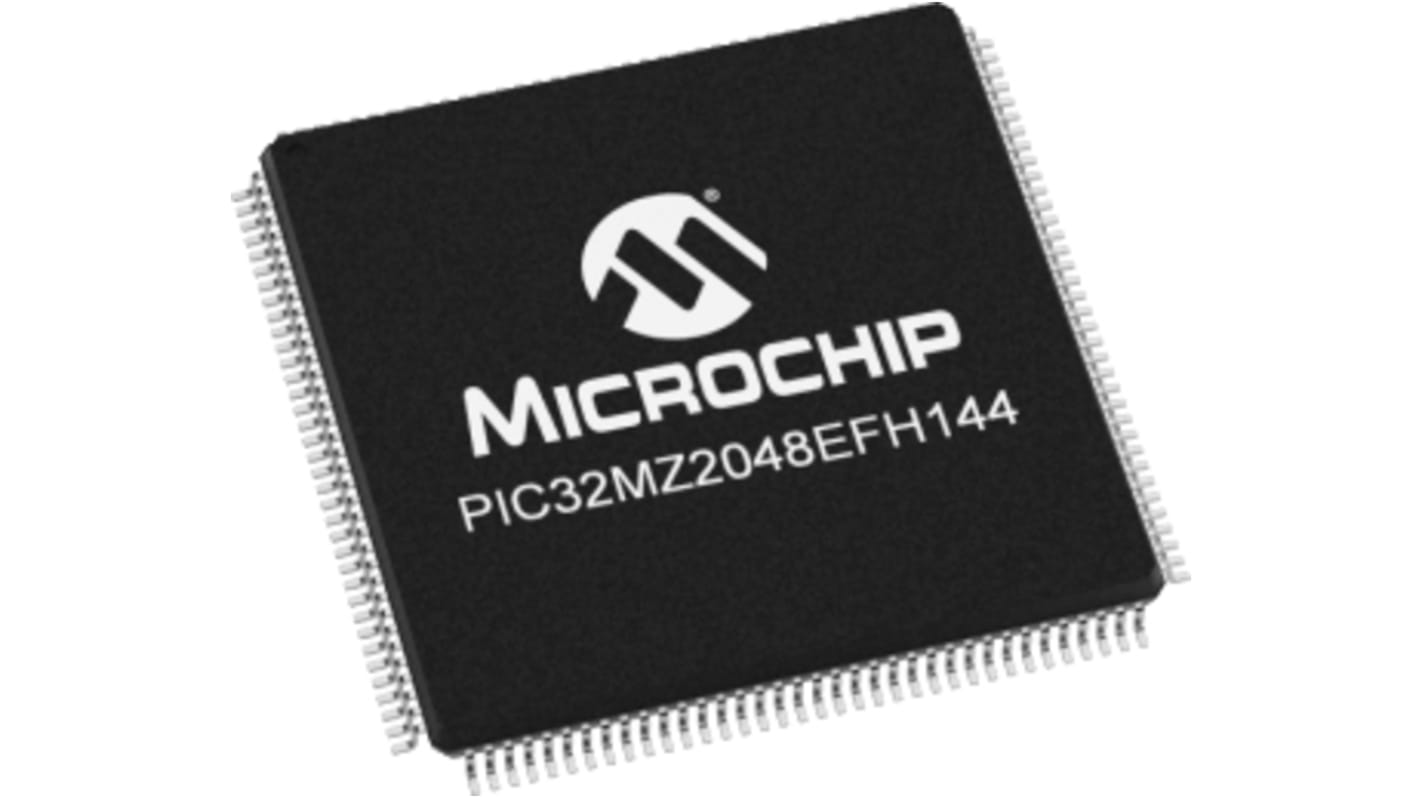
- RS Stock No.:
- 146-8868
- Mfr. Part No.:
- PIC32MZ2048EFH144-250I/PL
- Brand:
- Microchip
Select all | Attribute | Value |
|---|---|---|
| Brand | Microchip | |
| Family Name | PIC32 | |
| Package Type | LQFP | |
| Mounting Type | Surface Mount | |
| Pin Count | 144 | |
| Device Core | 32 bit CPU | |
| Data Bus Width | 32bit | |
| Program Memory Size | 2.048 MB | |
| Maximum Frequency | 252MHz | |
| RAM Size | 512 kB | |
| USB Channels | 0 | |
| Number of PWM Units | 0 | |
| Number of SPI Channels | 6 | |
| Number of UART Channels | 6 | |
| Typical Operating Supply Voltage | 2.1 → 3.6 V | |
| Number of CAN Channels | 2 | |
| Number of I2C Channels | 6 | |
| Number of USART Channels | 0 | |
| Instruction Set Architecture | DMIPS | |
| Program Memory Type | Flash | |
| Number of PCI Channels | 0 | |
| Minimum Operating Temperature | -40 °C | |
| Number of ADC Units | 1 | |
| Length | 20mm | |
| ADCs | 48 x 12 bit | |
| Number of Ethernet Channels | 0 | |
| Number of LIN Channels | 0 | |
| Height | 1.4mm | |
| Data Rate | 25Mbit/s | |
| Width | 20mm | |
| Dimensions | 20 x 20 x 1.4mm | |
| Pulse Width Modulation | 1 (9 Channel) | |
| Maximum Operating Temperature | +85 °C | |
| Automotive Standard | AEC-Q100 | |
| Maximum Number of Ethernet Channels | 0 | |
| Select all | ||
|---|---|---|
Brand Microchip | ||
Family Name PIC32 | ||
Package Type LQFP | ||
Mounting Type Surface Mount | ||
Pin Count 144 | ||
Device Core 32 bit CPU | ||
Data Bus Width 32bit | ||
Program Memory Size 2.048 MB | ||
Maximum Frequency 252MHz | ||
RAM Size 512 kB | ||
USB Channels 0 | ||
Number of PWM Units 0 | ||
Number of SPI Channels 6 | ||
Number of UART Channels 6 | ||
Typical Operating Supply Voltage 2.1 → 3.6 V | ||
Number of CAN Channels 2 | ||
Number of I2C Channels 6 | ||
Number of USART Channels 0 | ||
Instruction Set Architecture DMIPS | ||
Program Memory Type Flash | ||
Number of PCI Channels 0 | ||
Minimum Operating Temperature -40 °C | ||
Number of ADC Units 1 | ||
Length 20mm | ||
ADCs 48 x 12 bit | ||
Number of Ethernet Channels 0 | ||
Number of LIN Channels 0 | ||
Height 1.4mm | ||
Data Rate 25Mbit/s | ||
Width 20mm | ||
Dimensions 20 x 20 x 1.4mm | ||
Pulse Width Modulation 1 (9 Channel) | ||
Maximum Operating Temperature +85 °C | ||
Automotive Standard AEC-Q100 | ||
Maximum Number of Ethernet Channels 0 | ||
DSP-enhanced core:
Four 64-bit accumulators
Single-cycle MAC, saturating and fractional math
Dual Panel Flash for live update support
FPU for fast single- and double-precision math
12-bit, 18 MSPS, 48-channel ADC module
Memory Management Unit for optimum embedded OS execution
microMIPS mode for up to 35% code compression
CAN, UART, I2C, PMP, EBI, SQI & Analog Comparators
SPI/I2S interfaces for audio processing and playback
Hi-Speed USB 2.0 Device/Host/OTG
10/100 Mbps Ethernet MAC with MII and RMII interface
Temperature Range: - 40°C to 85°C, - 40°C to 125°C
- 40°C to 125°C
Microcontroller Features
Operating voltage range of 2.2V to 3.6V
2MB Flash memory (plus an additional 160 KB of Boot Flash)
512KB SRAM memory
microMIPS mode for up to 35% smaller code size
DSP-enhanced core:
Four 64-bit accumulators
Single-cylce MAC, saturating and fractional math
FPU for fast single- and double-precision math
Code-efficient (C and Assembly) architecture
Low-power management modes (Idle and Sleep)
Peripheral Features
50 MHz External Bus Interface (EBI)
50 MHz Serial Quad Interface (SQI)
Peripheral Pin Selectfunctionality to enable function remap
8 channels of hardware programmable DMA and 18 channels of dedicated DMA with automatic data size detection
Six UART modules (25 Mbps): Supports LIN 1.2 and IrDA protocols
Two CAN modules 2.0B Active with DeviceNet addressing support
Six 4-wire SPI modules (50 Mbps)
SQI configurable as an additional SPI module (50 MHz)
Five I2C modules (up to 1 Mbaud) with SMBus support
Parallel Master Port (PMP)
Hardware Real-Time Clock and Calendar
Nine 16-bit Timers/Counters (four 16-bit pairs combine to create four 32-bit timers)
Nine Capture inputs and Nine Compare/PWM outputs
Audio/Graphics/Touch HMI Features
Graphics interface: EBI or PMP
Audio data communication: I2S, LJ, RJ, USB
Audio data control interface: SPI and I2C™
Audio data master clock: Fractional clock frequencies with USB synchronization
Advanced Analog Features
12-bit ADC Module:
18 Msps rate with six Sample and Hold (S&H) circuits (five dedicated and one shared)
Up to 48 analog inputs
Can operate during sleep and idle modes
Multiple trigger sources
Six digital comparators and six digital filters
Two analog comparators with 32 programmable voltage references
Temperature sensor with ±2°C accuracy
Debugger Development Support
In-circuit and in-application programming
4-wire MIPS® Enhanced JTAG interface
Unlimited program and 12 complex data breakpoints
IEEE 1149.2-compatible (JTAG) boundary scan
Non-intrusive hardware-based instruction trace
Integrated Software Libraries and Tools
MPLAB Harmony - PIC32 software development framework
C/C++ compiler with native DSP/fractional and FPU support
TCP/IP, USB, Graphics and mTouch middleware
MFi, Android and Bluetooth audio frameworks
RTOS Kernels, Express Logic ThreadX, FreeRTOS, OPENRTOS, Micriμm, μC/OS and SEGGER embOS