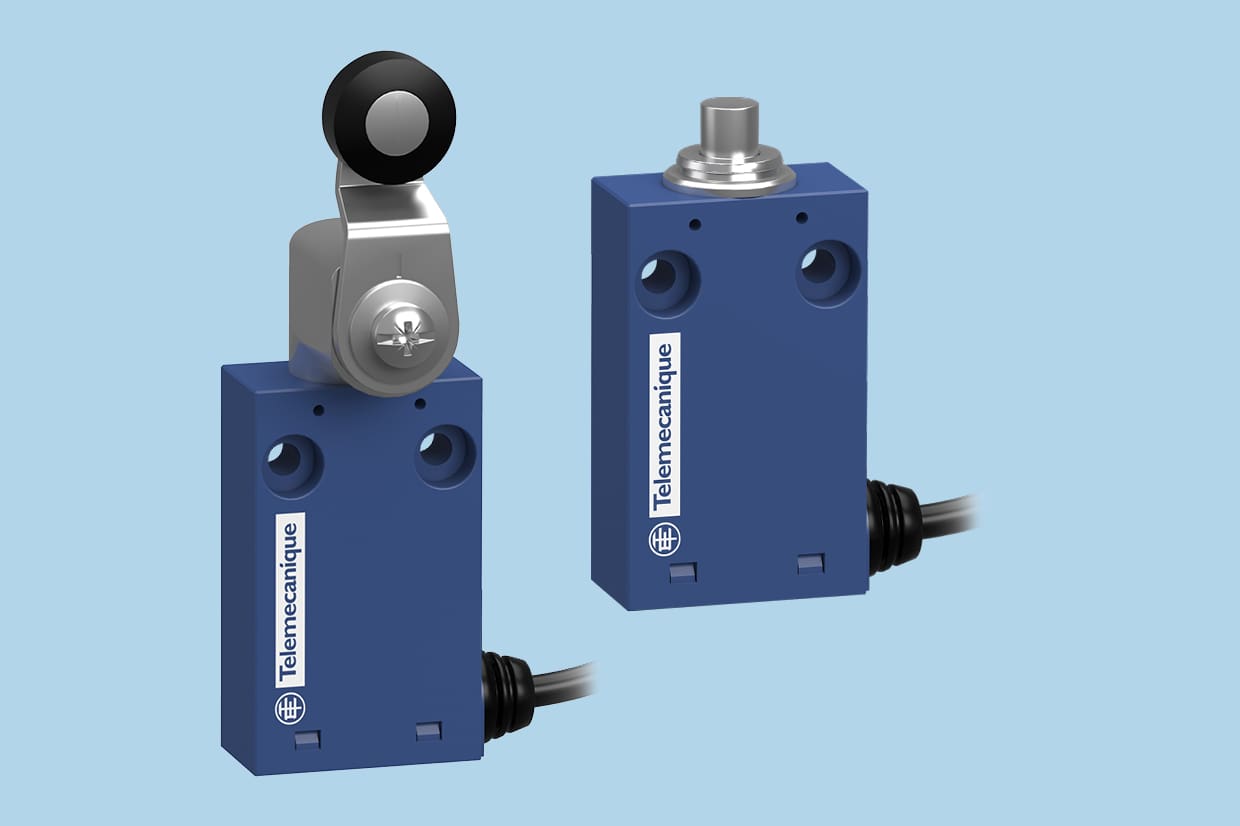
Telemecanique Sensors XCKJ Series Roller Lever Limit Switch, 1 NO/1 NC, IP66, Zamak Housing, 240V ac
- RS Stock No.:
- 700-4309
- Distrelec Article No.:
- 136-30-815
- Mfr. Part No.:
- XCKJ10541H29
- Brand:
- Telemecanique Sensors


Subtotal (1 unit)*
£94.90
(exc. VAT)
£113.88
(inc. VAT)
FREE delivery for orders over £60.00
Limited stock
- 48 left, ready to ship
- Plus 27 left, ready to ship from another location
Need more? Click ‘Check delivery dates’ to find extra stock and lead times.
Units | Per unit |
|---|---|
| 1 + | £94.90 |
*price indicative

- RS Stock No.:
- 700-4309
- Distrelec Article No.:
- 136-30-815
- Mfr. Part No.:
- XCKJ10541H29
- Brand:
- Telemecanique Sensors
Specifications
Technical Reference
Legislation and Compliance
Product Details
Find similar products by selecting one or more attributes.
Select all | Attribute | Value |
|---|---|---|
| Brand | Telemecanique Sensors | |
| Actuator Type | Roller Lever | |
| Product Type | Limit Switch | |
| IP Rating | IP66 | |
| Contact Configuration | 1 NO/1 NC | |
| Housing Material | Zamak | |
| Contact Type | Snap Action | |
| Terminal Type | Screw Clamp | |
| Series | XCKJ | |
| Minimum Operating Temperature | -25°C | |
| Switching DC Voltage | 250V dc | |
| Switching AC Voltage | 240V ac | |
| Maximum Operating Temperature | 70°C | |
| Length | 77mm | |
| Standards/Approvals | CCC, EN 60204-1, UL, IEC 60204-1, CSA | |
| Depth | 44mm | |
| Width | 40mm | |
| Hazardous Area Certification | No | |
| Mechanical Life | 30000000Cycles | |
| Conduit Entry | M20 | |
| Mounting Orientation | Multi Directional | |
| Select all | ||
|---|---|---|
Brand Telemecanique Sensors | ||
Actuator Type Roller Lever | ||
Product Type Limit Switch | ||
IP Rating IP66 | ||
Contact Configuration 1 NO/1 NC | ||
Housing Material Zamak | ||
Contact Type Snap Action | ||
Terminal Type Screw Clamp | ||
Series XCKJ | ||
Minimum Operating Temperature -25°C | ||
Switching DC Voltage 250V dc | ||
Switching AC Voltage 240V ac | ||
Maximum Operating Temperature 70°C | ||
Length 77mm | ||
Standards/Approvals CCC, EN 60204-1, UL, IEC 60204-1, CSA | ||
Depth 44mm | ||
Width 40mm | ||
Hazardous Area Certification No | ||
Mechanical Life 30000000Cycles | ||
Conduit Entry M20 | ||
Mounting Orientation Multi Directional | ||
- COO (Country of Origin):
- ID

Telemecanique Sensors XCKJ Series Limit Switch, IP66, Zamak Housing - XCKJ10541H29
This limit switch provides mechanical position detection and electrical switching for industrial automation and safety tasks. It is fitted with a roller lever actuator to translate linear or rotary movement into a snap-action electrical change and is intended for installation where a sealed control Interface is required.
Features and Benefits:
• IP66 ingress protection ensures dependable dust and water resistance
• Zamak housing offers robust metallic enclosure for harsh settings
• 1NO1NC snap-action contacts deliver quick switching response
• Rated for 240V AC and 250V DC switching for versatile control circuits
• M20 conduit entry simplifies standard cable gland installation
• Multi-directional mounting accommodates diverse actuator orientations
• Zamak housing offers robust metallic enclosure for harsh settings
• 1NO1NC snap-action contacts deliver quick switching response
• Rated for 240V AC and 250V DC switching for versatile control circuits
• M20 conduit entry simplifies standard cable gland installation
• Multi-directional mounting accommodates diverse actuator orientations
Applications
• Suitable for conveyor end-of-travel detection in manufacturing lines
• Ideal for machine guards requiring sealed switching elements
• Used with pneumatic cylinders for position confirmation
• Can be used for limit sensing on packaging equipment
• Used for assembly jigs where Compact sealed switches are needed
• Ideal for machine guards requiring sealed switching elements
• Used with pneumatic cylinders for position confirmation
• Can be used for limit sensing on packaging equipment
• Used for assembly jigs where Compact sealed switches are needed
What Terminal arrangement does it use for wiring?
The switch uses screw clamp terminals to secure conductors in control panels and junction boxes.
How does it perform in temperature extremes?
It operates across a range from -25°C up to 70°C, supporting indoor and temperature-controlled plant areas.
What durability can be expected from mechanical operation?
The mechanism is rated for 30,000,000 mechanical cycles, suitable for high-frequency actuation applications.
What ingress and hazardous-area limitations apply?
It meets IP66 for protection against dust and powerful water jets but has no hazardous-area certification.
Which standards and approvals support use in regulated installations?
It complies with EN 60204-1, IEC 60204-1 and holds CCC, UL and CSA recognitions for equipment safety and industrial use.
Approvals
UL; CSA
Related links
- Telemecanique Sensors XCKJ Series Roller Lever Limit Switch IP66 240V ac, 3A
- Telemecanique Sensors XCKJ Series Roller Plunger Limit Switch IP66 240V ac, 3A
- Telemecanique Sensors XCKJ Series Rod Limit Switch IP66 240V ac, 3A
- Telemecanique Sensors XCKM Series Roller Lever Limit Switch IP66 240V ac, 3A
- Telemecanique Sensors XCKD Series Roller Lever Limit Switch IP66 Zamak Housing 3A
- Telemecanique Sensors XCKJ Series Roller Lever Limit Switch IP66 240V ac, 1.5A
- Telemecanique Sensors XCKJ Series Roller Lever Limit Switch IP66 240V ac, 3A
- Telemecanique Sensors XCKJ Series Roller Lever Limit Switch IP66 240V ac, 3A