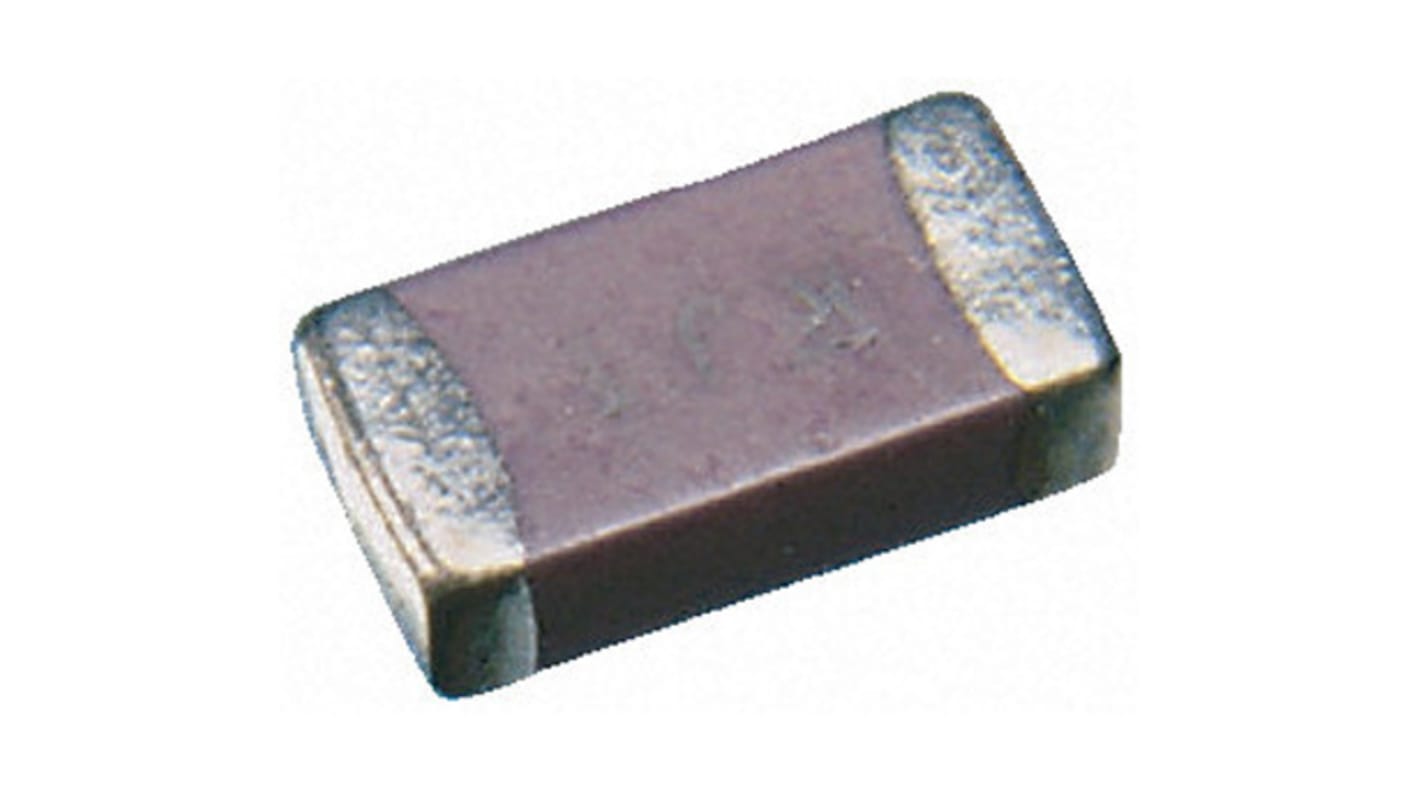
Vishay 100 nF Multilayer Ceramic Capacitor, 50V dc, ±10 %, Surface
- RS Stock No.:
- 173-0332
- Mfr. Part No.:
- VJ0805Y104KXAAT
- Brand:
- Vishay

Subtotal (1 reel of 3000 units)*
£120.00
(exc. VAT)
£150.00
(inc. VAT)
FREE delivery for orders over £60.00
Last RS stock
- Final 114,000 unit(s), ready to ship
Units | Per unit | Per Reel* |
|---|---|---|
| 3000 + | £0.04 | £120.00 |
*price indicative
- RS Stock No.:
- 173-0332
- Mfr. Part No.:
- VJ0805Y104KXAAT
- Brand:
- Vishay
Specifications
Technical Reference
Legislation and Compliance
Product Details
Find similar products by selecting one or more attributes.
Select all | Attribute | Value |
|---|---|---|
| Brand | Vishay | |
| Capacitance | 100nF | |
| Product Type | Multilayer Ceramic Capacitor | |
| Voltage | 50V dc | |
| Package/Case | 0805 | |
| Construction | Ceramic | |
| Mount Type | Surface | |
| Packaging | 7 in Reel/Paper Tape | |
| Dielectric | X7R | |
| Tolerance | ±10 % | |
| Automotive Standard | No | |
| Termination Type | Surface Mount | |
| Minimum Operating Temperature | -55°C | |
| Series | VJ | |
| Width | 1.25mm | |
| Height | 1.45mm | |
| Standards/Approvals | No | |
| Length | 2mm | |
| Maximum Operating Temperature | 150°C | |
| Select all | ||
|---|---|---|
Brand Vishay | ||
Capacitance 100nF | ||
Product Type Multilayer Ceramic Capacitor | ||
Voltage 50V dc | ||
Package/Case 0805 | ||
Construction Ceramic | ||
Mount Type Surface | ||
Packaging 7 in Reel/Paper Tape | ||
Dielectric X7R | ||
Tolerance ±10 % | ||
Automotive Standard No | ||
Termination Type Surface Mount | ||
Minimum Operating Temperature -55°C | ||
Series VJ | ||
Width 1.25mm | ||
Height 1.45mm | ||
Standards/Approvals No | ||
Length 2mm | ||
Maximum Operating Temperature 150°C | ||
RoHS Status: Exempt
VJ0805 Series
The VJ series of ceramic capacitors from Vishay come in various capacitance values, case sizes and voltage ratings. With C0G (NPO) and X7R dielectric options available in this series, VJ ceramic capacitors can cater for a range of applications. The C0G versions are ultrastable and offer you a very low temperature coefficient of capacitance.
Product Application Information
Wet build process
Reliable Noble Metal Electrode (NME) system
Excellent ageing characteristics
Suitable applications for these ceramic capacitors include surge suppression, filtering and decoupling. VJ series ceramic capacitors are ideal for use in sensor and scanner applications and also in timing and tuning circuits.
0805 Range
Nickel barrier terminations covered with a layer of plated Tin (NiSn). Applications include mobile phones, video and tuner designs, COG/NPO is the most popular formulation of the "temperature compensating", EIA Class I ceramic materials, X7R, X5R formulations are called "temperature stable" ceramics and fall into the EIA Class II materials, Y5V, Z5U formulations are for general purpose use in a limited temperature range, EIA Class II materials; these characteristics are ideal for decoupling applications.
Related links
- Vishay 100 nF Multilayer Ceramic Capacitor ±10 %, Surface
- Vishay 100 nF Multilayer Ceramic Capacitor ±10 %, Through Hole Radial
- Vishay 100 nF Multilayer Ceramic Capacitor 10 %, Through Hole Radial
- Vishay 100 nF Multilayer Ceramic Capacitor 10 %, Through Hole Axial
- Vishay 100 nF Multilayer Ceramic Capacitor ±5 %, Surface
- Vishay 100 nF Multilayer Ceramic Capacitor ±10 %, Surface
- Vishay 100 nF Multilayer Ceramic Capacitor ±10 %, Surface
- Vishay 100 nF Multilayer Ceramic Capacitor ±10 %, Surface