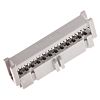
3M 24-Way IDC Connector Socket for Cable Mount, 2-Row
- RS Stock No.:
- 163-0545
- Mfr. Part No.:
- 3626-6600
- Brand:
- 3M


Currently unavailable
We don't know if this item will be back in stock, RS intend to remove it from our range soon.
Alternative
This product is not currently available. Here is our alternative recommendation.
Each
£2.08
(exc. VAT)
£2.50
(inc. VAT)
- RS Stock No.:
- 163-0545
- Mfr. Part No.:
- 3626-6600
- Brand:
- 3M
Specifications
Technical Reference
Legislation and Compliance
Product Details
Find similar products by selecting one or more attributes.
Select all | Attribute | Value |
|---|---|---|
| Brand | 3M | |
| Number of Contacts | 24 | |
| Number of Rows | 2 | |
| Gender | Female | |
| Pitch | 2.54mm | |
| Mounting Type | Cable Mount | |
| Body Orientation | Right Angle | |
| Termination Method | IDC | |
| Current Rating | 1A | |
| Contact Plating | Gold over Nickel | |
| Series | 3000 | |
| Minimum Operating Temperature | -55.0°C | |
| Maximum Operating Temperature | 105.0°C | |
| Contact Material | Copper | |
| Housing Material | PBT | |
| Select all | ||
|---|---|---|
Brand 3M | ||
Number of Contacts 24 | ||
Number of Rows 2 | ||
Gender Female | ||
Pitch 2.54mm | ||
Mounting Type Cable Mount | ||
Body Orientation Right Angle | ||
Termination Method IDC | ||
Current Rating 1A | ||
Contact Plating Gold over Nickel | ||
Series 3000 | ||
Minimum Operating Temperature -55.0°C | ||
Maximum Operating Temperature 105.0°C | ||
Contact Material Copper | ||
Housing Material PBT | ||
- COO (Country of Origin):
- US
3M IDC Connector Socket, 24 Way, 2 Rows - 3000 Series - 3626-6600
Need to quickly connect ribbon cables without stripping or preparation? Choose this industry-standard IDC (insulation-displacement contact) connector from 3M. Positive locking 'J' clips hold the covers securely in place, and they're coated with a transfer adhesive to hold them onto the ribbon cable and ensure precise alignment between the cable and the connector. The housing is made from robust polybutylene terephthalate (PBT), which contributes to the socket's wide operating temperature range of -55°C to +105°C for use in harsh industrial environments.
• Right-angled body orientation saves space when building your system
• Gold-over-nickel-plated copper contacts resist corrosion to offer reliable data transmission
• 2.54mm pitch is ideal for industry-standard 1.27mm-pitch ribbon cable
• Dual-slot and centre-bump military polarisation aids accurate mating with the header connector
• Gold-over-nickel-plated copper contacts resist corrosion to offer reliable data transmission
• 2.54mm pitch is ideal for industry-standard 1.27mm-pitch ribbon cable
• Dual-slot and centre-bump military polarisation aids accurate mating with the header connector
Applications
• Wire to board technology
• Internal wiring applications
• Test and instrumentation devices
• Medical equipment
• Internal wiring applications
• Test and instrumentation devices
• Medical equipment
How do you calculate the pitch of a ribbon cable?
The pitch of a ribbon cable is the distance between the individual conductors. To find the pitch, measure between the two outer conductors, then divide by the number of conductors.