- Published 8 Sept 2026
- Last Modified 8 Sept 2026
- 6 min
Microscopes – A Complete Guide
What are microscopes, what are their uses, and what types are available? Discover more in our complete guide.


This complete buyers’ guide to microscopes includes a detailed look into the various models that are available, explaining their key features and how microscopes are typically used on a day-to-day basis.
What are Microscopes?
Microscopes are familiar instruments, commonly found in laboratories around the world. They are used to magnify and examine objects and details which are often too small to see with the naked eye.
How Do Microscopes Work?
Microscopes use varying methods to magnify small objects and details, usually for scientific or industrial purposes.
The most widely used design is the optical microscope which directs light through a carefully calibrated combination of lenses with varying focal lengths. These curved pieces of glass or plastic then bend that light, spreading out the rays emitted by tiny objects under examination in order to generate a magnified image.
However, this is just one example and other types of microscope use entirely different methods to produce much more powerful magnification. We will cover some of the additional microscope types in the following section.
What are the Different Types of Microscope?
There are four principal types of microscope. These are:
Optical/Compound Microscopes
Main Benefits :
- The most common type of microscope
- Features eyepieces to view imagery
Ideal Applications :
- Microelectronics, biotechnology, microbiology, education
Stereo Microscopes
Main Benefits :
- Two eyepieces as standard
- 3D viewing
Ideal Applications :
- Studying solid objects, close work such as surgery or dissection, botany, working with electronics
USB Microscopes
Main Benefits :
- Portable plug-and-play functionality
- Imagery displayed on a PC screen
Ideal Applications :
- Examining flat objects and printed circuit boards, scientific research requiring the observation of moving objects such as microorganisms
Electron Microscopes
Main Benefits :
- High magnification and resolution
- Exceptional quality imagery
Ideal Applications :
- Scientific applications, studying biological and inorganic objects, industrial purposes including failure analysis and quality control
Let’s take a look at each type in more detail.
Compound Microscopes
The optical microscopes familiar from education and scientific laboratories are technically known as compound microscopes. This is because they combine two or more lenses to generate a magnified image. This distinguishes compound microscopes from simpler, single-lens microscopes – a category which includes magnifiers.
The main lenses within a compound microscope are:
- Objective Lens – directly above the glass slide on which the object under examination will be placed
- Ocular Lens – this is more commonly known as the eyepiece
These are both convex lenses, meaning that they curve outwards. In more complex models, both the objective and the ocular lens may consist of multiple lenses linked together.

How Does a Compound Microscope Work?
The short focal length objective lens focuses an image of the object under examination onto the upper ocular lens, which has a longer focal length.
Stereo Microscopes
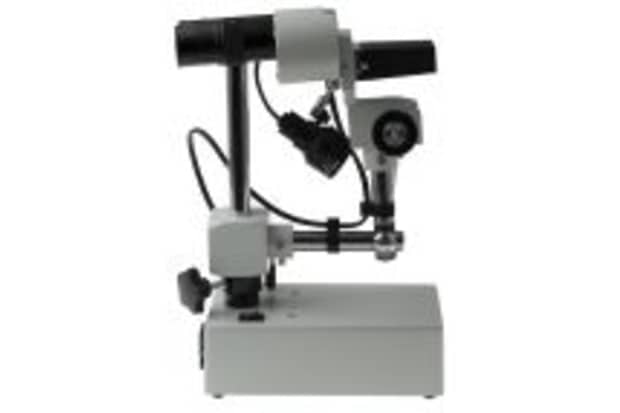
Stereo microscopes essentially combine two separate microscopes into one. This means that the instruments have two optical paths, each with their own objective and ocular lens.
The result is that slightly different viewing angles are produced for each eye, thereby generating a 3D image of the object under examination. These instruments are also known as dissecting microscopes.
USB Microscopes
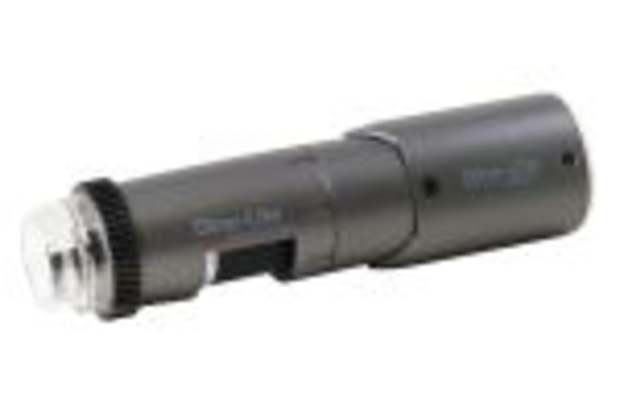
USB microscopes are powered by everyday USB ports. Instead of an eyepiece, USB microscopes display the magnified image onto a PC screen.
Some USB microscopes can be used with bespoke software, allowing greater flexibility and manipulation of the object being examined.
See for Yourself!
Take a look at our video to see the key features of the RS Pro Wi-Fi microscope and how it works.
These handheld digital microscopes feature built-in Wi-Fi transmission, enabling a seamless transition from instrument to screen. Wi-Fi microscopes offer a high degree of flexibility and greater functionality compared to alternative types, allowing the user to measure, copy, and transfer both images and video in real-time.
Video details
Transcript
Transcript
[music]
Electron Microscopes
Electron microscopes make use of an accelerated beam of electrons to generate an image of the object under examination. The image is produced as each electron bounces back onto the device’s specialist lens. Since they do not rely on conventional lenses, electron microscopes can produce images with significantly greater magnification and resolution.
Electron microscopes are typically powerful, high-end devices primarily used in scientific settings. There are two key types – SEM (scanning electron) and TEM (transmission electron). The former produces a 3D image and the latter produces a 2D image.
X-ray microscopes also work on a similar principle, using electromagnetic radiation to produce magnified images.
Popular Microscope Brands
Below are just a few examples of popular microscope brands. Each offers high-quality, specialist instruments ideal for a wide range of magnification purposes and applications.


Where are Microscopes Used?
Microscopes are widely used in laboratories and similar environments by professionals in a variety of scientific fields, including:
- Geology
- Biology
- Botany
- Medicine
- Forensics
- Chemistry
Microscopes are also used in industry – for example, pharmaceutical manufacturing and engineering. In addition, they are a common inclusion in education environments including school and university laboratories.
In each case, microscopes are used to examine fine details invisible to the naked eye or objects too small to be seen otherwise. This could include microscopic organisms, plant and animal cells, and chemical structures, to name just a few examples.
To cater to such a wide range of applications, microscopes are produced in different shapes and sizes, ranging from larger designs to light, portable handheld models.
How Much Magnification Do Microscopes Provide?
The magnification strength of a microscope varies between different models. Standard compound microscopes typically magnify objects by either 10, 20, 40, 100, or 400 times, but industrial models can generate images which have been magnified over 1,000 times. Some electron microscopes can take that even further, providing up to as much as 10 million times magnification.