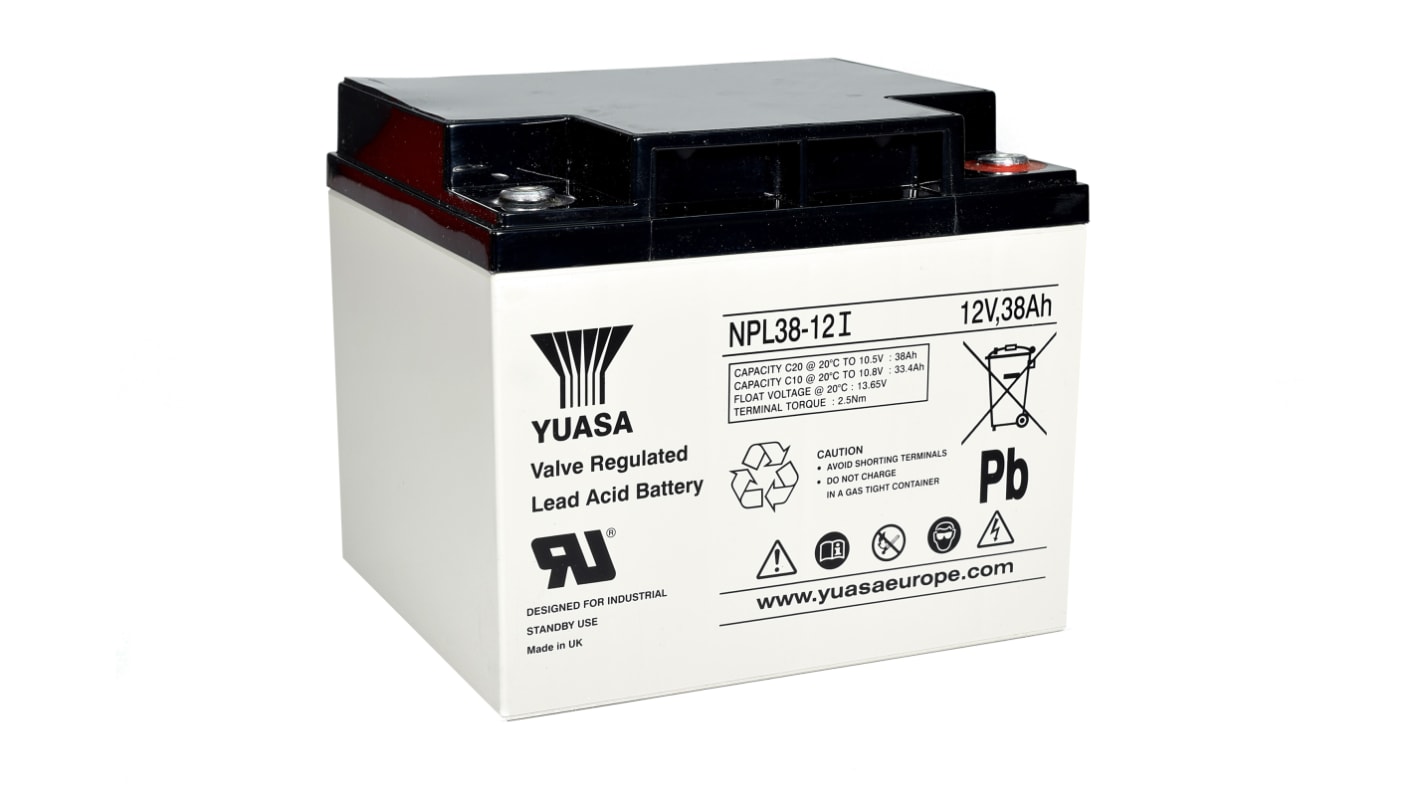
Yuasa 12 V Sealed Lead Acid Battery, 38 Ah, 165mm x 170 mm
- RS Stock No.:
- 198-8153
- Distrelec Article No.:
- 169-47-801
- Mfr. Part No.:
- NPL38-12
- Brand:
- Yuasa

Subtotal (1 unit)*
£232.66
(exc. VAT)
£279.19
(inc. VAT)
FREE delivery for orders over £60.00
Temporarily out of stock
- 26 unit(s) shipping from 22 April 2026
- Plus 66 unit(s) shipping from 08 May 2026
Need more? Click ‘Check delivery dates’ to find extra stock and lead times.
Units | Per unit |
|---|---|
| 1 + | £232.66 |
*price indicative
- RS Stock No.:
- 198-8153
- Distrelec Article No.:
- 169-47-801
- Mfr. Part No.:
- NPL38-12
- Brand:
- Yuasa
Specifications
Technical Reference
Legislation and Compliance
Product Details
Find similar products by selecting one or more attributes.
Select all | Attribute | Value |
|---|---|---|
| Brand | Yuasa | |
| Product Type | Sealed Lead Acid Battery | |
| Battery Capacity | 38Ah | |
| Nominal Voltage | 12V | |
| Construction | AGM | |
| Flame Resistant | No | |
| Designed for Cyclic Application | Yes | |
| Designed for High Rate Application | No | |
| Eurobat Classification | 10 to 12 Years | |
| Minimum Operating Temperature | -20°C | |
| Maximum Operating Temperature | 60°C | |
| Height | 170mm | |
| Weight | 14kg | |
| Standards/Approvals | No | |
| Width | 165mm | |
| Series | NPL38-12I | |
| Select all | ||
|---|---|---|
Brand Yuasa | ||
Product Type Sealed Lead Acid Battery | ||
Battery Capacity 38Ah | ||
Nominal Voltage 12V | ||
Construction AGM | ||
Flame Resistant No | ||
Designed for Cyclic Application Yes | ||
Designed for High Rate Application No | ||
Eurobat Classification 10 to 12 Years | ||
Minimum Operating Temperature -20°C | ||
Maximum Operating Temperature 60°C | ||
Height 170mm | ||
Weight 14kg | ||
Standards/Approvals No | ||
Width 165mm | ||
Series NPL38-12I | ||
RoHS Status: Exempt
- COO (Country of Origin):
- GB
Yuasa NPL Range
The Yuasa NPL series batteries set the standard for quality and excellence in the field of rechargeable batteries. These high-quality batteries ensure that no electrolyte leakages occur from the case or terminals. The NPL series range are an enhance version of the NP series, almost maintenance-free with the perfectly sealed construction and the recombination of gases within the cell.
Why would you buy an NPL Series Lead-Acid battery?
The NPL series offers a unique electrolyte suspension system incorporating a microfine glass mat (AGM) to retain the maximum amount of electrolyte in the cells. The valve regulated design of this battery is equipped with a safe low-pressure venting system, which releases excess gases and automatically reseals should there be a build-up of gas within the battery due to overcharging.
Features & Benefits
• Valve Regulated Lead Acid Battery (VRLA)
• Rechargeable
• 24 Ah to 65 Ah capacities
• Voltage: 12 V
• Operating temperature range: -20 to +60 °C
• Absorbed Glass Matt (AGM) technology with no free acid
• Superb recovery from deep discharge
• Useable in any orientation (except continuously inverted)
• 10 to 12yr designed service life
• ISO 9001:2000
• Compatible chargers available separately
Operating Temperature Range
• Charge: -20 °C to +50 °C
• Discharge: -20 °C to +60 °C
• Storage: -20 °C to +60 °C
Terminal Types
• M5, M6 threaded
12V Options
• NPL24-12: 24 Ah, RS stock no: 198-8074
• NPL38-12: 38 Ah, RS stock no: 198-8153
• NPL65-12I: 65 Ah, RS stock no: 198-8169
Typical Applications
It can be used in any orientation except in a continuous inverted position. Designed for industrial use as float or standby power applications such as;
Security and Fire
Telecoms
Emergency lighting systems
Medical equipment
Solar power systems
Uninterruptible power supplies
GEL Vs AGM Lead Acid Batteries
Absorbed Glass Mat
These batteries contain only enough liquid to keep the specially designed glass mat wet. The glass mat is made to wick the battery electrolytes between the battery plates. If the battery is broken no free liquid leaks out.
AGM batteries are preferred when a larger number of amps are required. The life expectancy remains excellent in most cases if they are not discharged more than 60% between recharges and/or recharged fully every 3-6 months.
Gel Cell Batteries
These batteries contain silica type gel, which is a thick paste-like material. It allows the electrons to flow between plates but will not leak in a gel battery if the case is broken.
Gel Cell Batteries don't offer the same power capacity as per the same physical size as AGM batteries. Gel cell batteries excel in slow discharge rates and slightly higher operating temperatures and with excellent deep cycle capability. Recharging these batteries must be done correctly or it will suffer premature failure.
FAQ's
Is a lead Acid Rechargeable Battery Harmful?
Lead-Acid batteries contain chemicals that have the potential to be harmful to both your health and the environment. They contain lead which is a highly toxic metal and sulfuric acid which is a corrosive electrolyte solution. Proper handling procedures must be followed always.
What state of charge will the battery be in when delivered?
The NPL Range will have 90% to 95% of charge approximately, we do recommend charging prior to use.
How to dispose of Lead Acid Batteries?
Lead acid batteries do contain hazardous chemicals, so recycling is the only way to dispose of them.
Recycle responsibly. A wide range of schemes are available.
Note
These batteries should be charged with a constant voltage charger at 2.3V per cell standby and 2.5V per cell with a current limit of 0.25 x capacity (Ah) for cyclic applications (max 20 hour charging).
Warning
Do not charge in a sealed enclosure
Related links
- Yuasa 12 V Sealed Lead Acid Battery 165 mm x 170 mm
- Yuasa 12 V Sealed Lead Acid Battery 165 mm x 170 mm
- RS PRO 12 V 38 Ah, 165 mm x 170 mm
- Yuasa 12 V Sealed Lead Acid Battery 165 mm x 175 mm
- Fiamm 12 V Sealed Lead Acid Battery 165 mm x 170 mm
- RS PRO 12 V 38 Ah, 170 mm x 197 mm
- Yuasa 12 V Sealed Lead Acid Battery 175 mm x 125 mm
- Yuasa 12 V Sealed Lead Acid Battery 130 mm x 169 mm