Parallax Inc Propeller QuickStart MCU Development Kit 40000
- RS Stock No.:
- 779-2719
- Mfr. Part No.:
- 40000
- Brand:
- Parallax Inc

Unavailable
RS will no longer stock this product.
- RS Stock No.:
- 779-2719
- Mfr. Part No.:
- 40000
- Brand:
- Parallax Inc
Specifications
Technical Reference
Legislation and Compliance
Product Details
Find similar products by selecting one or more attributes.
Select all | Attribute | Value |
|---|---|---|
| Brand | Parallax Inc | |
| Classification | Development Kit | |
| Kit Name | Propeller QuickStart | |
| Technology | MCU | |
| Processor Part Number | P8X32A | |
| Select all | ||
|---|---|---|
Brand Parallax Inc | ||
Classification Development Kit | ||
Kit Name Propeller QuickStart | ||
Technology MCU | ||
Processor Part Number P8X32A | ||
- COO (Country of Origin):
- US
Propeller Quickstart Evaluation Board
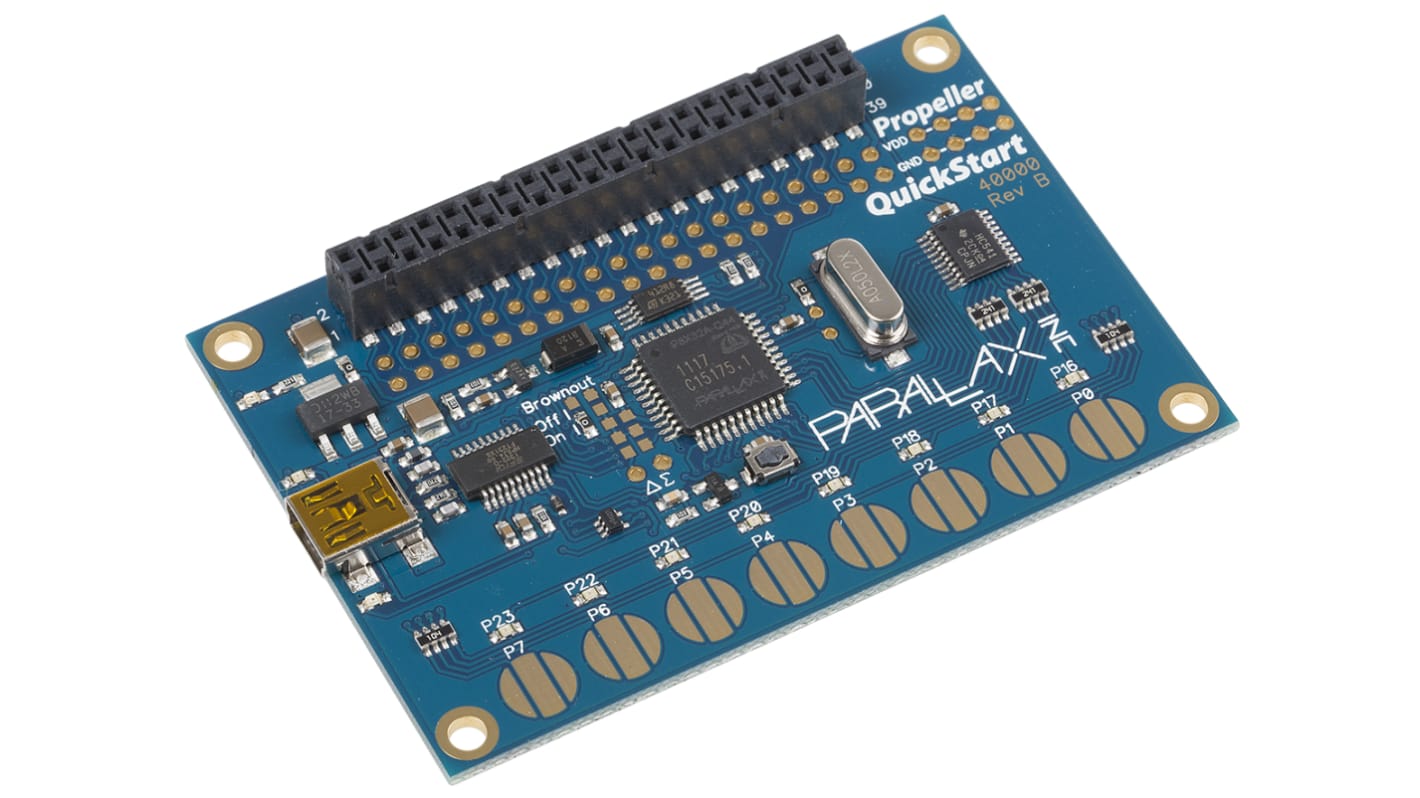
The QuickStart is an evaluation board for the Propeller. As an Open-Source reference design the QuickStart board provides basic Propeller circuitry. Developers may use our PCB layout files as their own to speed their project towards completion. As a project board the QuickStart is fully expandable and provides unimpeded access to all I/O pins through an expansion header but includes some button inputs and LEDs to demonstrate programming. With USB power and a selection of QuickStart Project examples it's also the fastest way to get up and running.
Propeller 8-core 32-bit microcontroller, 64KB EEPROM (32KB for program, 32KB for general-purpose use)
Bus-powered USB coupled with 3.3V regulator for 500mA
5MHz crystal on board may be disabled by removing SMT jumper, allowing replacement with external through-hole crystal
External brownout reset may be installed by removing SMT jumper
8 x blue LEDs on P16-P23
8 x resistive touch-buttons on P0-P7
Pads for sigma-delta A/D circuitry (two resistors and two capacitors, both 0603 footprint)
Expansion header provides access to Vss, Vdd, 32 I/O pins (28 x GPIO, 2 for I²C bus and 2 for optional Tx/Rx if connected to USB power)
Dimensions: 51 x 76mm
Open hardware reference design through our Altium and DipTrace PCB layout files (more export options may be possible)
Bus-powered USB coupled with 3.3V regulator for 500mA
5MHz crystal on board may be disabled by removing SMT jumper, allowing replacement with external through-hole crystal
External brownout reset may be installed by removing SMT jumper
8 x blue LEDs on P16-P23
8 x resistive touch-buttons on P0-P7
Pads for sigma-delta A/D circuitry (two resistors and two capacitors, both 0603 footprint)
Expansion header provides access to Vss, Vdd, 32 I/O pins (28 x GPIO, 2 for I²C bus and 2 for optional Tx/Rx if connected to USB power)
Dimensions: 51 x 76mm
Open hardware reference design through our Altium and DipTrace PCB layout files (more export options may be possible)
The Propeller™ 1 microprocessor chip makes it easy to rapidly develop embedded applications. Its eight 32-bit processors (COGs) can operate simultaneously, either independently or cooperatively, sharing common resources through a central hub. The developer has full control over how and when each cog is employed; there is no compiler-driven or operating system-driven splitting of tasks among multiple cogs. A shared system clock keeps each cog on the same time reference, allowing for true deterministic timing and synchronization. Two programming languages are available: the easy-to-learn high-level Spin, and Propeller Assembly which can execute at up to 160 MIPS (20 MIPS per COG).