- Published 9 Sept 2026
- Last Modified 9 Sept 2026
- 5 min
Norway is Leading the Way in Smart Mobility Solutions


Norway, “the land of the midnight sun”, is best known for its beautiful landscapes, its Viking heritage, and now its Smart Mobility. It's well known that Norway is now all electric for vehicles on the road and it's also one of the leading countries to achieve net zero carbon.
Recent government incentives such as tax reductions and subsidies, as well as lower fees for using the roads, are the reasons why the electric car market in Norway has grown so fast, with almost 80% of new car sales now electric.
One program that Norway has launched is Smart Mobility, with the aim of reducing global greenhouse gas emissions. Now, more than ever, it's important that transport plays a significant role by becoming more sustainable. However, electrifying transport alone cannot solve these challenges. Transport must become smarter and more flexible, with fewer resources.
What is Smart Mobility?
Smart mobility refers to numerous methods of transportation across several industries. It typically refers to public transport and urban transport schemes. These schemes include things like car sharing, autonomous transport systems, and electric transportation - both vehicles and urban mobility such as e-bikes and scooters.
Smart mobility usually falls under the brackets of becoming a smart city, and involves optimising and improving transport and communications for the goals of sustainability, efficiency, safety, and improved air quality. Many cities across Europe are embracing smart mobility solutions to offer citizens a better, greener, and smarter way of life.
What are the Key Focus Areas?
Mobility-as-a-Service
Mobility-as-a-Service includes car sharing, shared micro-mobility, e-scooters, taxis, and public transportation.
The idea of sharing the roads has been around for several years to try and reduce the overall road traffic, cost of transportation for citizens, and emissions. Many services have arisen to offer these services, usually using SaaS, such as Turo. A start-up company in Norway, Sammevei, has launched a ride-sharing application that aims to avoid traffic jams, helping users save money whilst taking care of the environment.
According to NAF, an average Norwegian is standing in traffic jams for an average of 20 minutes during a car journey. During rush hour, drivers in Norway sit alone in 6 out of 7 cars.
This results in long queues resulting in loss of time and money, as well as unnecessary CO2 emissions.”
Samkjøring | SammeVei
By reducing car traffic by approximately 10% during rush hour, traffic will flow much more freely. The solution is ridesharing to and from a destination. To achieve this, SammeVei has developed a ridesharing app that connects people to daily destinations. Thanks to Innovation Norway, SammeVei was able to secure a 4 million NOK grant in 2019, helping to develop its application for public and private use.
Electrification
We already know that the demand for electric vehicles has increased dramatically in Norway in the last few years. Whilst the demand is incredibly positive, drivers may struggle to find available chargers. This is down to several variable factors but one of those factors is having access to real-time data about available charging stations, their status, and price.
The SmartCharge application provides a solution to this problem. It's a cloud-based app that enables total control and automation of the EV infrastructure in Norway, including remote maintenance. It allows EV (electric vehicle) charging station owners to sell their own generated power.
The SmartCharge dashboard gives operators access to its historical data and can manage its operations, energy optimisation, and payments. They also could include dynamic pricing based on user, owner, and time.
The app helps drivers to locate the right EV charge station based on their individual requirements. It can calculate the optimal route, taking traffic data into consideration. The app also includes the facilitation of payments.
Logistics
Solving complex problems requires complex algorithms. Machine learning platform Epigram AI is developing an artificial intelligence system to analyse charging behaviour and improve planning related to EV charging.
This will prove to be hugely beneficial to large cities, ensuring that there is sufficient charging availability during peak times where it is needed most. This type of approach to EV infrastructure could prove invaluable in the future.
Autonomy
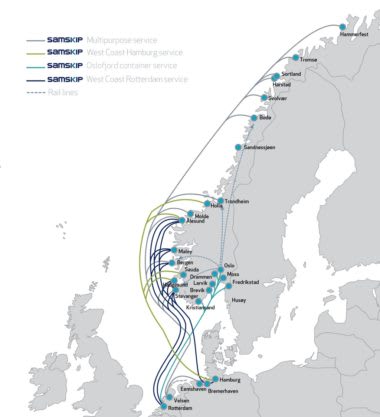
Autonomising aspects of the transport system, including vehicles, will lead to better efficiency and a reduction in emissions. Dutch company Samskip is developing autonomous, zero-emission systems for transferring freight from sea to road.
Sustainability is at the heart of our business, and our goal is to continue connecting our logistics transport systems efficiently and reducing CO2 emissions. Multimodal logistics is a green transportation method that reduces transportation costs, shortens transportation time, improves transportation quality, reduces road congestion and is environmentally friendly. It can reduce carbon emissions and noise pollution while improving energy efficiency.
Samskip
Samskip has a long history of serving Norway and has built up valuable experience, strong local presence, and an extensive customer base. Frequent containerised multimodal services connect Norway with the rest of Europe.
Connectivity and Analytics
Data is a huge part of artificial intelligence and automated systems.
Tracsense is developing a system for real-time monitoring of road conditions. Cloud-enabled machine learning allows TracSense to predict the next-mile road conditions, as well as further down the road. An advanced predictive algorithm incorporates the latest weather forecasts to offer accurate road conditions for every road. The car-mounted sensor provides in-situ updates to this estimation, thereby increasing the forecast accuracy. This approach allows TracSense to offer hyper-local road condition estimations in real-time.
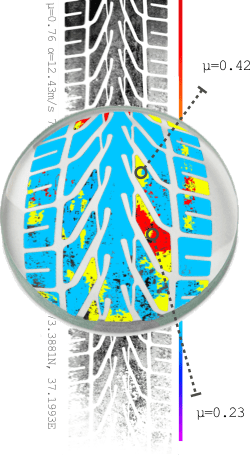
Road-to-wheel friction determines the braking distance and vehicle manoeuvring limits. TracSense offers ADAS (Advanced Driver Assistant Systems) and self-driving cars the intelligence to guarantee safe operations in all weathers. TracSense car-mounted sensors and cloud services are designed for seamless integration into the vehicle's on-board systems.
Increasing situational awareness of pending road conditions significantly increases road safety. Accurate local information for drivers and car onboard systems offers the opportunity to effectively mitigate risks.
Smart Mobility Solutions are Making Zero-Emission Cities a Reality
Ambitious policies and a vibrant ecosystem for smart mobility solutions have given Norway an edge in electrification. Norway is becoming the hub for innovation to Smart Mobility solutions, thanks to its government agendas and the public adoption of such technology.
There is a myriad of benefits to a green transition in the public transport sector as well. Modern technology will not only reduce emissions, but it can also improve freedom of movement and boost safety and security.