- Lorna Little
- Published 28 Oct 2026
- Last Modified 6 Nov 2026
- 9 min

The Empowered Engineer: Transitioning to Industry 5.0
Industry 5.0 puts engineers back at the centre of industrial systems. It represents the age of human-robot collaboration on the factory floor. Here's how cobots, precision T&M, and upgraded computing hardware are driving that change.


Industry 5.0 is a new era for the interaction of engineers with their work systems. It’s a considerable leap from the Industry 4.0 era, where the focus was on automating workflows to reduce human input.
Industry 5.0 gives decision-making back to engineers working with collaborative robots, or cobots. A cobot is a machine that handles repetitive physical work in a manufacturing workplace. It exists to give engineers more time to focus their skills on improving operational performance and outcomes.
For Industry 5.0 to work, though, companies need a workforce trained and confident enough to use it. They also need the cobots, computing, and equipment to deliver the results this sea change in production promises.
Learn more about how engineers are adapting to Industry 5.0 with insights from Dr Manish Chauhan, a Lecturer in Medical Engineering within the School of Physics, Engineering and Technology at the University of York.
Industry 5.0: The Evolution from Automated Efficiency to Human Synergy
Automation was a key win of the Industry 4.0 epoch. The erasure of procedural manual work saved time, cut costs, and reduced waste. Connected systems meant machines talked to each other. Data-driven production looked for and delivered greater system efficiencies.
As with the current rise of AI, employers thought they could do more with fewer people. It caused a change in the way they viewed and employed engineers. That resulted in many engineers feeling relegated to bystander status. They were watching screens instead of being able to work hands-on with their equipment.
Soon, however, problems like knowledge loss and an over-dependence on tech began to emerge. This caused a shift in thinking, which has led to Industry 5.0.
The European Commission's Industry 5.0 framework reflects these sentiments. The Commission noticed that the pendulum had swung back in engineers’ favour. Manufacturers are now valuing human input more highly. Having a person in the loop provides resilience against the unexpected. It can also increase sustainability.
In today’s plants and factories, technology is no longer the production lead. Cobots and other equipment are evidence gatherers and consultation tools. They spot the problems sooner and work with engineers on the solution.
"AI did not suddenly appear,” Dr Chauhan explains.
“There are almost 80 or 100 years of previous efforts which have gone into its development. We are just in the last phase of that part, and we’re lucky that we are able to directly use it.”
The fruitfulness of this collaboration can be seen in the rising adoption of cobots. Statistics from the International Federation of Robotics show installations reached 64,542 in 2024, up 12% year on year.
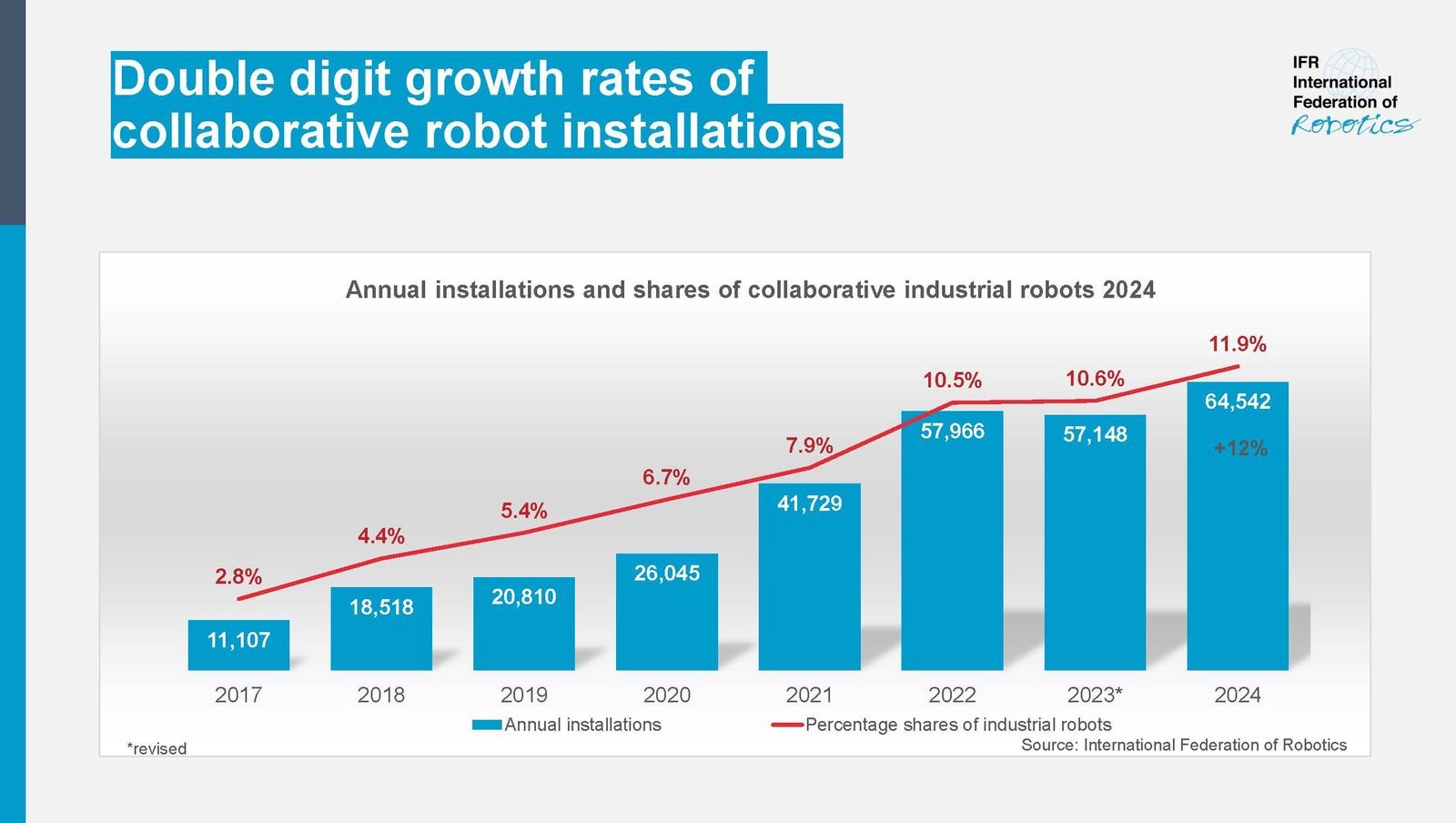
Cobots also made up 11.9% of industrial robot installations worldwide. The UK has been slower on the uptake and is currently 19th worldwide for robot installations.
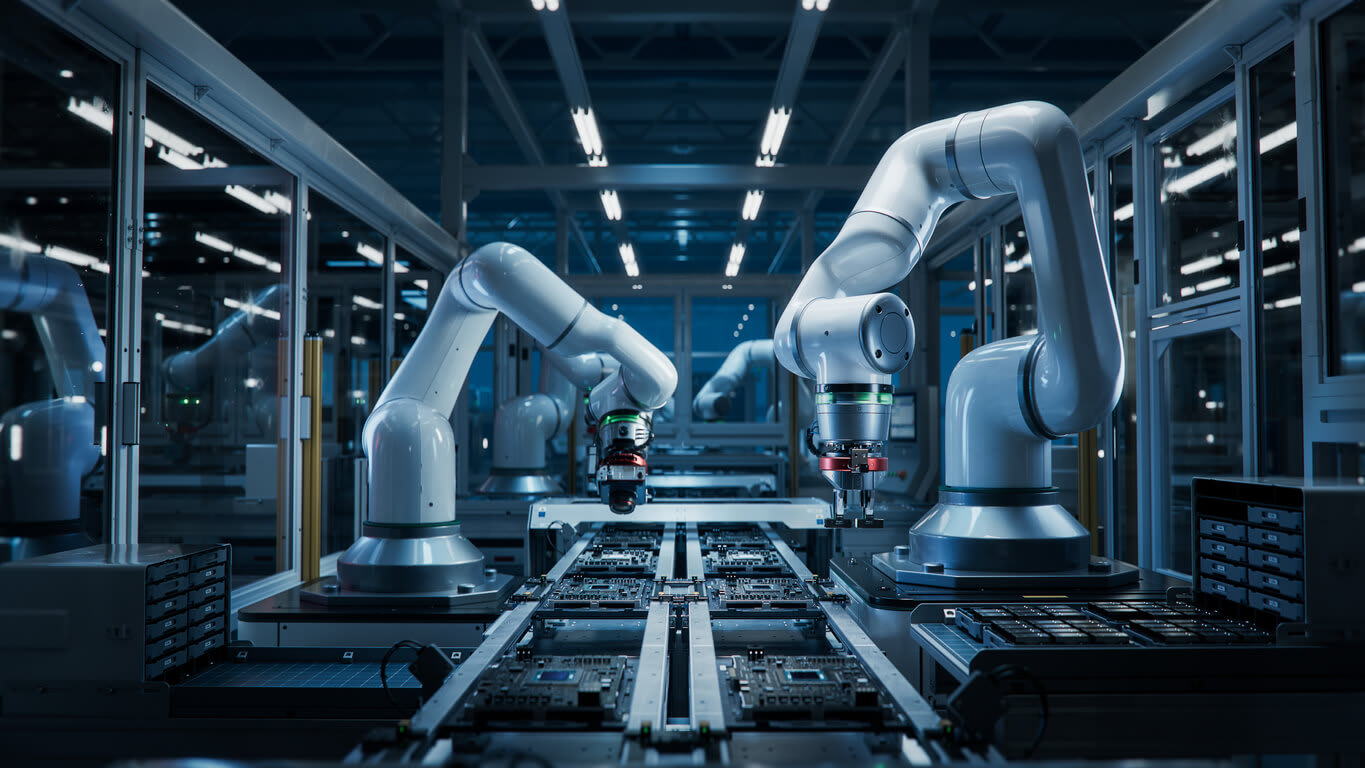
Prioritising the Human Element in Industry 5.0
Humans are now front and centre of the Industry 5.0 change. Tech was not the replacement that manufacturers first thought it would be. It can still deliver the heavy lifting, but it needs a human expert for direction.
One advantage tech will always have over humans is in data rates. Machines output data at a tremendous speed and volume that no human can keep up with. Now, with software monitoring and output interpretation, engineers only step in as needed. They can spend their time on the work that needs their expertise rather than staring at a monitor.
"That's one area which we generally now look into, looking for the end-user perspective,” Dr Chauhan explains.
“Patient-wise, it should always be safe. It should be safe from the surgeon's perspective, such as how easy it is for them to use ergonomically repeatedly."
AI-powered tech can also suggest remedies, which are helpful for an engineer under pressure to find fixes. Live data, once the authority behind decisions, is now secondary to the judgement of an engineer.
"Clinicians say that if a device needs to go in an NHS setting, we have our protocol on how the operation or surgery needs to be done, so that device needs to fit into that loop,” Dr Chauhan explains.
“They will not change the loop because I, as an inventor, know how to make a very innovative device, and I tell them, now you change your methods because I have a new device that doesn't work. So I need to look at the clinical workflow, how the existing setup is there, and how my device can get integrated into it."
The Physical Interface of Collaboration with Cobots
Cobots have specific features that make them safer. Among those features are force-limited joints and integrated/environmental sensors.
"For haptic feedback, we generally have some good commercial tools that are available, such as a force dimension tool and a haptic master device,” Dr Chauhan explains.
“There are seven degrees of freedom haptic devices which are available, and roboticists use them for training or providing haptic feedback to patients or to the doctors.
“There are also physics-based engines available. They are used for providing this feedback so that those feelings or the real interaction of the tool with the object itself are replicated and fed back through the physics engine at the user end."
Unlike other industrial robots, they are no longer locked away behind cages. Governing safety in this space is ISO/TS 15066:2016, which sets out each cobot's force, speed, and contact limits.
Engineers and cobots now work side by side, allowing each to perform to their strengths. Cobots are already taking on demanding tasks in the automotive, electronics, and food and beverage sectors. This allows engineers to concentrate on fault-finding, quality checks, and process improvement.
Giving Engineers the Edge with Precision T&M
Test and measurement (T&M) equipment picks up what the human eye and ear can miss. For example, thermal imaging cameras pick up the following heat signatures:
- Electrical faults
- Overloaded circuits
- Loose connections
- Worn parts
“When testing [surgical robotics], I would first make a small prototype and check for cytotoxicity induced by those devices in a lab-based environment,” Dr Chauhan explains.
“I’d put it in contact with skin or tissue and keep it in an incubator at 37° C and 5% CO2 for a certain amount of time, so I can see how the material reacts with the tissue. Does it produce any cytotoxic chemicals, or does it cause any physical changes in the tissue's texture or the cell lining? That's primarily what I would look into first."
Now, engineers can see potential faults long before they turn into a visible failure. Many companies use these diagnostics as part of a preventive maintenance programme. That means fewer surprise breakdowns and less reactive repair work. That’s beneficial for the bottom line.
Sound level meters play a different but equally practical role. Noise levels can change in human-cobot workspaces with new equipment, movements, and workflows. For health and safety purposes, there is a need to track these noise levels.
Meters assist safety managers and engineers in checking exposure and spotting changes in machine behaviour. A new noise pattern may indicate wear, loosened parts, or poor alignment before they become a fault.
Cobots provide engineers with a way to catch risks early, before a system alert.
Upgrading Computing and Peripherals for 5.0
Industry 5.0 hardware will keep up with the volume and speed of data production. That information needs to show on the engineer's monitor. They need to clearly see thermal overlays, cobot status feeds, and process dashboards.
In smart factory and IoT environments, the quality of the interface directly affects decision-making quality.
"That's where the real mathematics comes in,” Dr Chauhan explores.
“Where you have to dynamically design the kinematics of the software; that's where people focus on simulations. There is industry-grade software that helps people define the kinematics of the robot, like if we apply a certain amount of pneumatic pressure, how will it bend and what angles will it bend.
"This software, this data, the engine this works from; they're basically databases filled with pre-existing data of interactions. What happens is that they calibrate all these forces, and somebody has meticulously put it these in to a database, which is very useful for all other researchers to use.
“These databases are the precursor to the AI revolution which we are now facing."
Other equipment, like keyboards and input devices, also needs to be resilient. Industry 5.0 technology must survive in workplaces where lighting, dust, and vibration are constant factors.
Building a Resilient Workforce via Tech-First Upskilling
Industry 5.0 requires the right personnel to operate it and make use of its advantages. In the UK, this has become an issue.
Make UK's 2025 Skills Commission report spells out the current gap. As of 2025, UK manufacturing had 55,000 unfilled long-term vacancies. That costs the economy £6 billion annually in lost output. The Institution of Engineering and Technology found that only 61% of employers believe their current workforce is fit for the future.
"If you’d ask me what one basic skill is still missing, I’d say that ‘vision’ is missing,” Dr Chauhan explains.
“Students [in higher education] think that if they do a general engineering degree that will help them get a job in the market. My perspective is, please do not train yourself to be a job seeker; train yourself to be a job giver.
“Any country that wants to become an economic superpower doesn’t need oil, it doesn’t need nuclear weapons; it needs knowledge. If you invest in knowledge, and if the current youth is brought up with skills that will be relevant for the next 10 or 20 years, only then will the country remain stronger economically."
Until this changes, the onus will be on experienced engineers transferring their knowledge base. That transfer will be incomplete unless experienced staff learn how to use new Industry 5.0 hardware and software.
That said, younger workers tend to be more comfortable with digital equipment. There are opportunities for both younger and more experienced workers to exchange information.
"University programs are improving, and interdisciplinary skills are being introduced,” Dr Chauhan explains.
“For example, in our degree programs [at the University of York], we are now introducing skills through project-based learning. Students come to universities where they do interdisciplinary projects in teams, even at the individual level as well.
“New programs are now coming because AI is here, so universities are re-framing their degrees to introduce AI-based skills as well."
To transition to the new age, identify the hardware and software you need and put it into the hands of your staff. From there, build and execute training around it.
The practical path forward is straightforward. With its better tools and more precise data, Industry 5.0 is how you will get the best out of your engineers.

Dr Manish Chauhan is a Lecturer in Medical Engineering within the School of Physics, Engineering and Technology at the University of York. He bridges robotics and medicine to reshape the future of healthcare through groundbreaking work in physical AI deployment, biomedical diagnostics, surgical interventions, targeted implants, and wearable technologies for rehabilitation and therapeutic care.
His interdisciplinary research spans molecular biology, ultra-fast photonics, spectroscopy, and clinical trials incorporating tissue, cadaveric, and simulator-based testing. Dr Chauhan was previously a Marie Skłodowska-Curie Fellow at the STORM Lab at the University of Leeds and is currently Director of the ReAMA Lab, leading efforts to translate conceptual rigour into defensible, real-world healthcare solutions.

Lorna is an SEO Content Specialist at RS, where she creates search-led content focused on topics including industrial innovation, engineering, maintenance, and procurement. After studying Creative & Professional Writing at Canterbury Christ Church University, she built her career in SEO and content marketing across both agency and in-house environments, helping readers navigate technical subjects through informative, user-focused content. Outside of work, Lorna enjoys reading, travelling, and making memories with her family.
Related Articles
Industry 5.0 - The Next Phase of the Industrial Revolution
The world has embraced Industry 4.0, but is it ready for Industry 5.0?
Read more
Is Your Business Ready for Industry 5.0?
The fifth industrial revolution is already here. How can you prepare manufacturing for the changes associated with it?
Read more

The ‘Smart Factory’ Skill Gap Crisis
The 'Smart Factory' needs smarter skills. We analyse the critical talent gap threatening digital transformation and how to adapt with a steady learning culture.
Read more