- Justyna Matuszak
- Published 8 Sept 2026
- Last Modified 29 Oct 2026
- 5 min

Lighting for Hospitals & Medical Facilities - UVC LEDs


In today’s world, where viruses threaten society, reducing the risk of coming into contact with harmful pathogens has become key. Along with improving the air quality and ventilation, ultraviolet UVC lighting has gained more popularity as medical facilities seek more non-disposable, non-chemical disinfection options.
Ensuring a clean and safe hospital environment is crucial for the safety of patients and the medical workforce. Therefore, constant improvements are essential in the healthcare industry to provide high-quality facility performance and also to reduce energy and maintenance costs. One solution is Ultraviolet-C Light-emitting diodes (UVC LEDs) that destroy dangerous pathogens in water, surface and air.
At RS, it is important that the equipment we distribute is of the highest quality and safety, especially when it’s used in hazardous workplaces. Some of our supplier partners include OSRAM or Intelligent LED Solutions that are drivers of innovation in the semiconductor sectors.
What are UVC LEDs?
Besides the general lighting that is important for medical personnel’s working conditions, the lighting we will be focusing on in this article is UV light. This type of light helps organisations minimise the spread of superbugs, which linger in patient rooms and lead to new infections.
LEDs are semiconductor devices that are constructed from numerous layers of substrate materials. They can be created to accept wavelength input and output photons in the UV-C range, which can be utilised to prevent bacterial replication. Ultraviolet (UV) disinfection can help fight dangerous pathogens, such as E. Coli, MRSA and C. diff.
Another term that complements the UVC is UVGI (Ultraviolet Germicidal Irradiation). UVGI is ‘the use of ultraviolet (UV) energy to kill viral, bacterial, and fungal organisms’, according to the Centres for Disease Control and Prevention. UVC LEDs are small, so they can be used in many different devices, including air purifiers, medical equipment, and water purifiers.
Benefits of using UV Light for disinfection
UV disinfection lighting improves both patient experience and staff’s ability to work efficiently and with special care. The key aspect of UVC LEDs is the UVC light that should be emitted at very precise wavelengths, as that is the main factor that destroys pathogens.
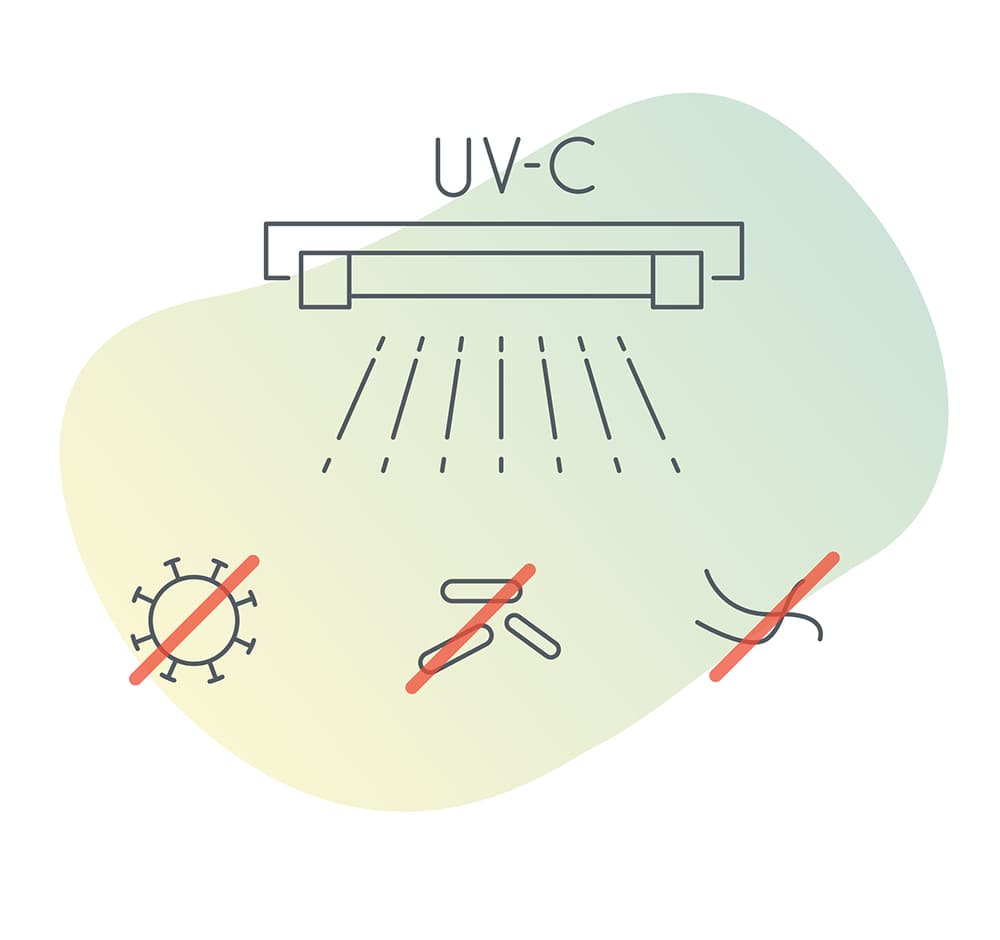
Features of UV light disinfection products:
- Can kill up to 99.9% of bacteria and viruses
- Takes two seconds to destroy microorganisms
- Compact size
- Non-toxic
- Narrow spectrum of output centred on a specific wavelength
- Low power consumption
- Low heat generation
UV Light disinfection products safety standards
Each product with a specific application has to comply with some standards. Users or customers purchasing such equipment should know how to use the products and ensure that these devices have been tested and examined. RS offers products that come with relevant data sheets, so before making a purchase, our customers have all the necessary information about the product they wish to purchase
As UCI Beckman Laser Institute & Medical Clinic claims, it is important to remember that for UV to kill germs, it has to be shining for a certain time and at certain wavelengths.
Things to keep in mind before buying UV light disinfection products:
Types
There are different types of ultraviolet C lamps with different specifications. Some make a lot of UVC light and disinfect in a short time. The most common four types are:
- Low-pressure mercury lamps: similar to fluorescent lamps with a wavelength of 253.7 nm. They produce a small amount of visible light because of additional bands of mercury radiation. Both mercury lamps with low and high pressures have negative resistance, hence an external ballast is needed to control the current flow.
- High-pressure mercury lamps: more similar to HID lamps than fluorescent lamps, are widely used in water treatment. They radiate a broad-band UVC radiation, producing bright bluish white light.
- Excimer lamps: depending on the medium, excimer lamps emit narrow-band UVC and vacuum-ultraviolet light at a range of wavelengths. They produce less heat than mercury lamps and reach peak output more quickly. Excimer emission at 207 and 222 nm seems to be less harmful compared to conventional 254 nm germicidal radiation.
- LEDs: as mentioned at the beginning of this article, solid-state UVC LEDs generate light using semiconductor components. By modifying the semiconductor material's chemistry, it is possible to tailor the emission wavelength, which gives the LED's emission profile selectivity over and beyond the germicidal wavelength band.
Wavelength
It is vital to pay attention to the wavelength as it can impact the device’s effectiveness at destroying viruses. It can also cause health and safety risks. The product you will buy should be able to kill pathogens without causing too much health risk. The UVC devices available in the market cover a wavelength spectrum from 200 to 280 nm. According to the International Ultraviolet Association, to eliminate pathogens, specifically germicidal ultraviolet in the 240 - 280 nm range should be used.
Surface
Since it can be challenging to reach all the locations where the virus can appear, UVC solutions typically perform poorly on surfaces with ridges and bumps. They work better on hard, non-porous surfaces.
Safety features
It is important to ensure that such lamps are safe and do not cause an exposed light, for example, by choosing ‘enclosed products’ with auto switch off function.
Avoid looking at the light
UVC radiation can potentially cause injuries, so people should avoid continued contact with the skin and not stare straight at the illumination as its long-term effect on humans is still unknown.
Recommended Products

- RS Stock No. 825-1571
- Mfr. Part No. ILH-XT01-S365-SC211-WIR200.
Each
£123.69

Meeting hospital demands for a complete UV disinfection solution
Lighting is a key to efficient healthcare. Thus UVC LEDs are perfect for the equipment manufacturing and medical environments to integrate this disinfection technology into new and exciting products that protect patients from Healthcare-Associated Infections (HAIs). With the products mentioned above, you can ensure that the operation, whether in a hospital, surgical centre or clinic, will be effective and safe. However, it is important to keep in mind that some of the UVC lamps can cause some harm if bought without clear specifications and user manual.

Justyna is a Digital Content Writer at RS, responsible for writing and managing content. She studied Journalism and Social Communication with a specialisation in social media and e-PR. In that time, she participated in journalist internships in Wroclaw (PL) and London. She is passionate about tech innovations, the shift to a digital world and the impact technology has on our lives. Her interests are sport, music and film photography.