- Justyna Matuszak
- Published 9 Sept 2026
- Last Modified 29 Oct 2026
- 7 min

The Development of Advanced Wearables


Wearables, also known as activity trackers that count steps and calories, can now offer valuable insights about health which could prevent diseases and medical emergencies.
Today, wearable technology can save people’s lives. Smartwatches not only help people stay fit, but also notify about medical emergencies and inform about the user’s state of health to help fend off illnesses. According to Wireless Quarter, 325 million people use wearables worldwide.
This article focuses on how wearables have improved from being just activity trackers a decade ago to advanced devices that help prevent illnesses today. We cover how wearable technology works, which components it needs, and how it revolutionises the healthcare industry.
The Role of Wearables in Detecting Health Conditions
With the development of IoT, wearable devices can monitor a patient's physiological data, such as blood oxygen, heart rate, saturation, respiratory rate, and temperature.
Wearable technology gained significant popularity in the fitness sector and became an important tool during the COVID-19 pandemic. As a result, the medical field has shown increasing interest in these devices, which enable healthcare professionals to monitor patients remotely over extended periods outside of hospital settings. Wearables now play a vital role in the prevention, management, and monitoring of a wide range of health conditions, including diabetes, hypertension, and sleep apnea, as well as neurocognitive disorders such as Parkinson's and Alzheimer's.

Wearables enhance communication between the patient and the doctor who previously needed to base their patient’s analyses on the medical record and history. Doctors and other health providers may use the extensive data to make early diagnoses, undertake remote patient tracking, and assure medication adherence.
Technology Behind Wearables - AI and ML
The newest wearables are powered by SoCs (System-on-a-chip), SiPs (system-in-a-package), and the machine learning (ML) algorithms that aid in the construction of the most complex medical wearables. With computing on edge devices, wearables are designed to indicate underlying health issues and provide doctors with information that is necessary to make rapid clinical decisions.
"Computing on edge devices such as wearables is getting progressively more energy efficient and powerful while algorithms are more streamlined and energy optimised."
Peter Myhre, Head of Product Marketing at Nordic Semiconductors
Components Used in Wearable Technology
Intelligent wearables use a variety of technologies, such as sensor technology, display technology, chip technology, wireless communication technology, data computation and processing technology, power endurance technology, and data interaction technology.
The development of these devices presents significant challenges, as the human body is constantly in motion. Consequently, wearable systems must be durable, adaptable, and ideally washable when embedded in clothing or accessories, or otherwise designed to be easily removable.
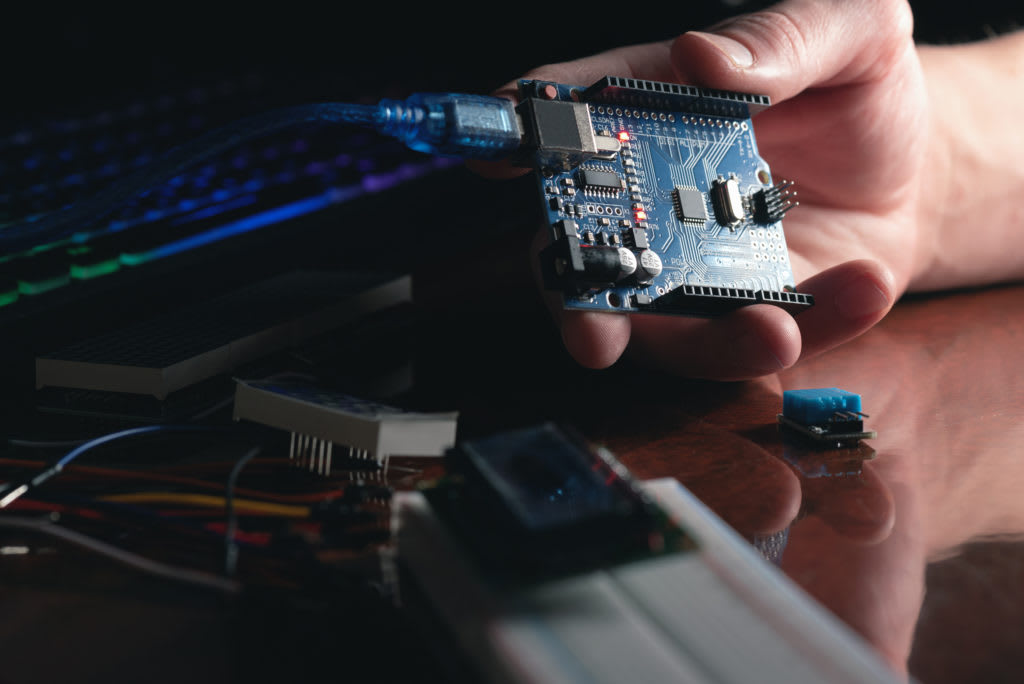
Therefore, the design focuses on sensor integration, miniaturisation, and multifunctionality. Some of the commonly used components in wearables design include:
Sensors
Sensors are in all wearable devices, giving insights into activity and physiological parameters. The user can have a clear knowledge of their overall health and fitness performance by being able to measure vitals including blood oxygen levels, body temperature, and heart rate.
Different types of sensors are used in wearables:
- Pressure sensors
- Humidity sensors
- Position sensors
- Temperature sensors
- Piezo film sensors
- Force sensors
As wearable technology is growing, there is increased demand for more accurate, compact, and reliable sensing technologies. Therefore, manufacturers design more advanced technological solutions.
For example, a Polish medical startup, Warmie, designed a sensor powered by Nordic Semiconductor's nRF52810 SoC, which allows the device to assess multiple parts of the body and inform users or doctors of possible health problems.
Another brand is TE Connectivity, which produces sensors suited for wearable devices and smart watches. TE Connectivity is a global leader in innovative sensor solutions, providing components that are already present in popular wristbands, watches, and smartwear.
Switches
Switches are components that control how much electrical current flows through a circuit. They are an essential part that can be utilised as an input device for wearable technology. They can be used as input devices to control a device's functionality, although they are more frequently used to turn on equipment.
It's crucial to carefully choose the proper switch during the design phase since wearable devices have a limited amount of space. The majority of switches are tactile. However depending on the design requirements, they can also be positioned vertically or at an angle.
RND offers tactile switches that have a small, wearable design appropriate for keyboards and high-speed data transmission equipment. If you are looking for side switches, Omron provides DIP switches that are washable and suitable for small, computer, and handheld devices.
Passive Components
A passive component is a piece of electronic equipment that requires electrical power to operate. Depending on how it will be used in an electrical circuit, the component can then release, absorb, or retain the energy. The most common types of passive components are resistors, capacitors, and inductors.
Vishay offers professional thin film chip firm resistors, ideal for the majority of sectors in modern precision electronics where stability and reliability are key considerations. They are suitable for applications in precision test and measuring equipment, for instance non-critical medical equipment like wearables.
Semiconductors
Semiconductors are the brain of wearable technology; they interpret data from sensors or other inputs and deliver a useful result. The expansion of the wearables business has been accelerated in large part by developments in the semiconductor sector. Devices such as microcontrollers, diodes, transistors, or timers and counters are critical for properly functioning embedded systems. For instance, using highly sensitive diodes allows for biometric monitoring, such as blood oxygen and heart rate monitoring.
Connectors
In wearable technology, connectors can be used for antennas, sensors, power, battery connections, board-to-board, wire-to-board, and removable memory devices. They link peripherals to the primary device and facilitate simple repairs in the event that a component fails.
With the USB 3.1 Type-C Connector from Molex you can benefit from excellent reliability, ensure great durability, and avoid damage from connector abuse thanks to the mid-plate connector tongue design. It's designed to provide robust and reliable performance for wearables, the Internet of Things, and other high-speed data I/O applications.
RF & Antennas
The majority of advanced wearable devices are incorporated with IoT and, depending on the RF technology, require antennas. The antenna may be an SMD antenna, one that is hardwired into the PCB, or, in extremely rare circumstances, an external antenna.
With a range of multi-band antennas available for virtually any device configuration, there are antenna, RF, and communication module solutions to suit a variety of applications. For example, GPS/GNSS antennas help improve the reliability and accuracy of wireless positioning and navigation systems.
Power
Most wearables need a power connector for charging the battery, as well as a battery connector such as a coin cell holder or a LiPo battery 2-wire or 3-wire terminal. The majority of wearables utilise USB connectors for charging, while occasionally manufacturers will create their own exclusive connector.
Development Boards
Due to the small size, wearable PCB designs have different standards than the commonly used printed circuit boards. There are many factors to bear in mind before choosing the right PCB board, such as board surface materials, RF/microwave design, and RF transmission lines. Luckily, some manufacturers design boards suitable for wearable technology.
The nRF5340 SoC from Nordic Semiconductor provides wearable developers with a strong application processor as well as a totally programmable extremely low power network processor. The processor's dual design makes it ideal for complicated IoT applications such as healthcare devices. With security features, ML, and artificial intelligence (AI) capabilities, it's easier to manage the constant stream of data provided by modern wearables.
Besides Nordic Semiconductor, there are other brands that provide wearable solutions. Have a look at our recommended products below.
Recommended Products

- RS Stock No. 139-3651
- Mfr. Part No. MIKROE-2554
Each
£18.77

- RS Stock No. 198-3804
- Mfr. Part No. MIKROE-3776
Each
£21.02

- RS Stock No. 288-3968
- Mfr. Part No. WRL-15663
Each
£22.33

- RS Stock No. 139-3650
- Mfr. Part No. MIKROE-2510
Each
£42.79
FAQs

Justyna is a Digital Content Writer at RS, responsible for writing and managing content. She studied Journalism and Social Communication with a specialisation in social media and e-PR. In that time, she participated in journalist internships in Wroclaw (PL) and London. She is passionate about tech innovations, the shift to a digital world and the impact technology has on our lives. Her interests are sport, music and film photography.