- Published 8 Sept 2026
- Last Modified 8 Sept 2026
- 7 min
Digital Twin in Health Sector


Technology advances now allow ‘copying’ our reality to virtual worlds, and it is one of the most trendy concepts, often related to the word digital twin. Big tech organisations and companies are focusing on creating as accurate as possible replicas of the world we live in and other physical things. Technologies like IoT, AI, VR, sensors, 3D printing, and metaverse open up more opportunities for new development in the health sector.
Digital twins are dimensionally-exact 3D digital models that can be swiftly updated to reflect changes with their physical counterparts. The growth of this technology is made possibly by artificial intelligence and machine learning technology. Therefore, the digital twin is popular in engineering applications as a mainly manufacturing concept. We have written about the digital twin and its importance in industry already, but today, the focus is fully on digital twins in the healthcare and medical sectors.
How Does Digitalisation Improve Healthcare?
In the healthcare industry, the list of digital twin advantages is already unbelievable and still growing. From creating a virtual model of a person's body, even down to the molecular level, to deciding which surgical procedure would be most effective or being capable of anticipating a patient's response to experimental therapies without putting their lives at risk, digital twins can offer a safe setting for testing how modifications will affect a system's performance. They allow for evaluation and monitoring without being nearby. Problems can be foreseen before they occur, giving time to make the necessary adjustments or follow the proper procedures.
The mirrored world will allow healthcare leaders to bring data and intelligence together at unprecedented scales; ask and answer big-picture questions critical to their survival; and reimagine how they operate, collaborate and innovate.
Accenture, Mirrored world
More Personalised Medicine
Personalised medicine, also called precision medicine, allows for easier tailoring of medical treatments to individuals based on their particular genetic makeup, anatomy, behaviour, and other aspects. Precision medicine is gaining popularity as it satisfies specific individuals' needs according to medical decisions and therapies. It is made possible by digital twins. How? Digital twins create the potential to build a more personalised medicine, and below you can find some examples:
Virtual Organs
Digital twins are being used in medicine to replicate the real body, and create virtual and customisable organ models. In order to assess the evolution of diseases over time or the response to new medications, therapies, or surgical interventions, several companies have been working on virtual hearts that can be tailored to individual patients and updated.
For example, Philips created a Dynamic HeartModel, a clinical tool that enables cardiologists to evaluate various heart functions important for the diagnosis and care of patients with CVD.
Tommaso Mansi and his research team at Siemens Healthineers have been developing a computational model of a digital heart that is accessible on a computer. This is a prototype that definitely revolutionises precision medicine. The objective is to make it possible for the doctor to employ the digital twin's predictive guidance in real-time while performing a surgery, potentially boosting the number of patients who could benefit from the therapy.
Also, European firm FEops has already launched the Heartguide platform, where virtual copies of the heart or its substructures are created from cardiac scans using cutting-edge technology. Through the use of this technology, FEops hopes to enhance and broaden the tailored care for patients with structural heart disease.
Body Scanning
If you have seen Star Trek and you remember a body scanner that can create a 3D computerised representation of your body to monitor your health, now the science fiction movie vision has become a reality. Jeff Kaditz, an American start-up CEO, designed Q Bio Gemini, the first digital twin platform to scan the whole body. According to the company's website, its advanced computational physics models, which are more accurate than traditional MRI for many illnesses, can record a whole-body scan in 15 minutes without the use of radiation or breath holds.
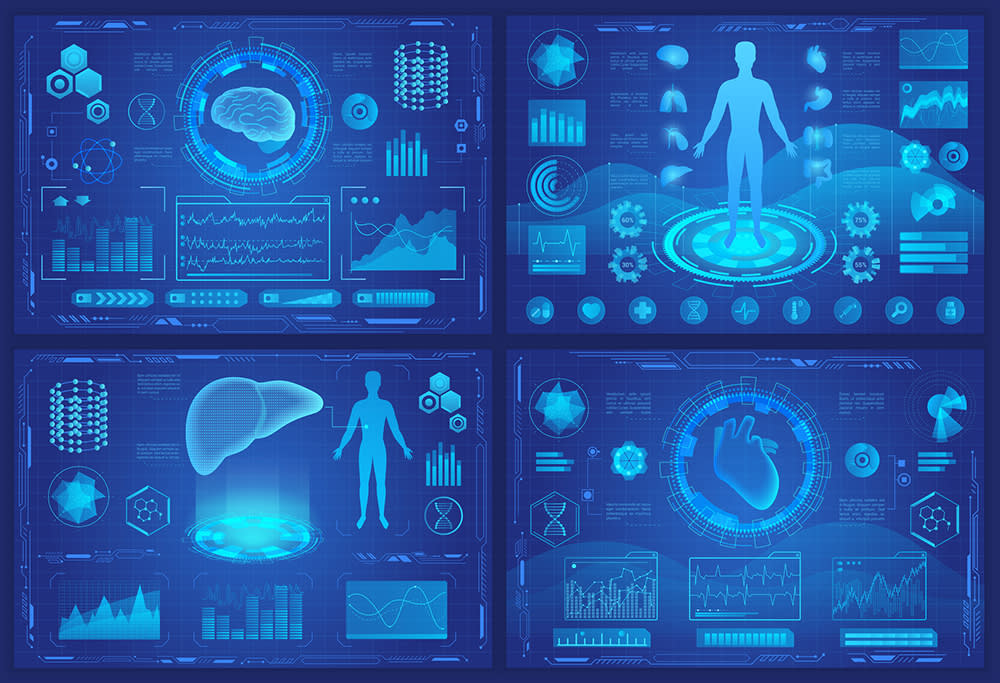
Patient Data
A patient's health information, including medical records, the results of diagnostic tests and examinations, a history of prescription medications, and data from wearables and other sources, can be gathered and stored to construct a digital twin of the patient.
Therefore, there are more and more apps that help keep track of a person's health changes throughout time. Wearable sensors and cutting-edge algorithms can anticipate the beginning of infection, inflammation, and insulin resistance. For more information about wearables, check out this article . Wearable technology gives some insights into heart rate, physical activity, skin temperature, and other health data. The digital twin might be used to identify changes in health status and possible dangers that call for additional research when paired with pre-existing information about illness progression and data analysis.
Digital Twin Simulations
Digital twin simulation enables the virtual representation of models that can create data to help in research and development. This technique is very important in healthcare as it allows medical personnel to predict the outcome before selecting treatment or therapy. With a virtual representation, it is possible to determine which treatment or solution would be best for a patient by testing it first on a digital replica of their body or organ, rather than on the patient themselves.
Digital Twin in Surgery
The idea behind a surgical digital twin is that a patient model is built, and surgery may be planned in a multidisciplinary team conference, practised beforehand in a simulator, and referred to during the operation to check anatomy and minimise unintended structural damage. Such methods can help prevent the errors that could occur during an operation and allow doctors to prepare better for what will happen.
Patient Monitoring
Predictive analysis through simulation allows for detecting symptoms at an early stage. With some illnesses, preventing and recognising diseases at the right time might save someone’s life. Thanks to the digital twin assistance, doctors have real-time access to information.
How Does the Digital Twin Continue to Evolve in Healthcare?
The examples highlighted within this article are only a few, intended to show how digital twin technology helps with the diagnosis and treatment of serious illnesses. Digital twin research focuses on particular situations or ailments, such as cancer, heart trouble, and critical care, as well as in general helping with patients' medical records, laboratory results, genetic data, optimal decision-making, and simulating various scenarios before implementation in the real world.
Technologies such as AI, machine learning, 3D modelling, and predictive analytics are key for effective digital twins and creating accurate data models. Also, with the protection of patient data and integration, as well as the evaluation of IoT-enabled devices and improved monitoring of healthcare facilities, digital twins have become an important factor in the development. Still, they will evolve in the medical sector focusing on Software-as-a-Medical-Service. This will increase the popular appeal of digital twins and make the technology more viable for healthcare organisations.
Have a look at the products below and change your facility into a smart future of healthcare.
Recommended Products

3D Printers
Healthcare benefits highly from additive manufacturing. 3D printing is used in the healthcare industry to create external prostheses, cranial or orthopaedic implants, and personalised airway stents. However, it has also proven useful in surgical planning and has been used in difficult open-heart surgeries or even in the procedure of face transplant. Read about the industrial applications of 3D printing to find out more about how it improves medical manufacturing and dental production.

Servo Controllers
The TMCM-1636 is a single axis servo drive for 3-phase BLDC motors and DC motors rated at +24V or +48V. It has a CAN and UART interface and can communicate using either the TMCL or CANopen protocols. Besides being commonly used in laboratory automation, robotics, manufacturing, motorised tables, and chairs, servo drivers can be found in a variety of common medical applications, such as:
- Tables for patient handling
- Ventilation for patient breathing
- Fake portable hearts
- Bone saws
- Injection of contrast

Energy Meters
The smart future of healthcare cannot happen without smart meters. Some of this equipment is energy meters that work by assisting in identifying inefficiencies. Submetering all the facility's equipment allows staff to observe exactly how much energy each component consumes.
Applications:
- Monitor power consumption for each floor, office sector, or unit
- Allocate energy cost to lower cost of operations, optimise your building’s power efficiency
- Connect to power management software to take full advantage of the IoT digital power installation

Programmable Logic Controllers
Artificial intelligence machine automation controllers enable machine learning and optimisation on the edge with rapid and accurate control by synchronising all EtherCAT devices, such as vision sensors, servo drives, and field devices, and anomaly identification by visualising error sites. Because PLC systems make it easy to gather and send operational data, healthcare systems are using PLCs in central utility plants for integration, remote monitoring, and automated control of mechanical-electric systems. Thanks to that, they accomplish operational efficiency and high-quality patient care.

Serial Device Servers
Signal device servers from Moxa (NPort 5410 series) are medically EN60601-1-2 and EN55011 certified. Moxa networked servers assist nurses in connecting several serial-based bedside monitoring devices. As a result, medical workers can electronically monitor their patients' conditions and use EMR to replace traditional paper charting (electronic medical records).

Power Meters
Power monitoring equipment actively monitors and analyses the dedicated facility's electrical power distribution infrastructure, which includes MV, LV, operating rooms, and intensive care units.
Medical Disclaimer
All content in this article is for informational and educational purposes only, and does not substitute professional medical advice or consultations with healthcare professionals.